

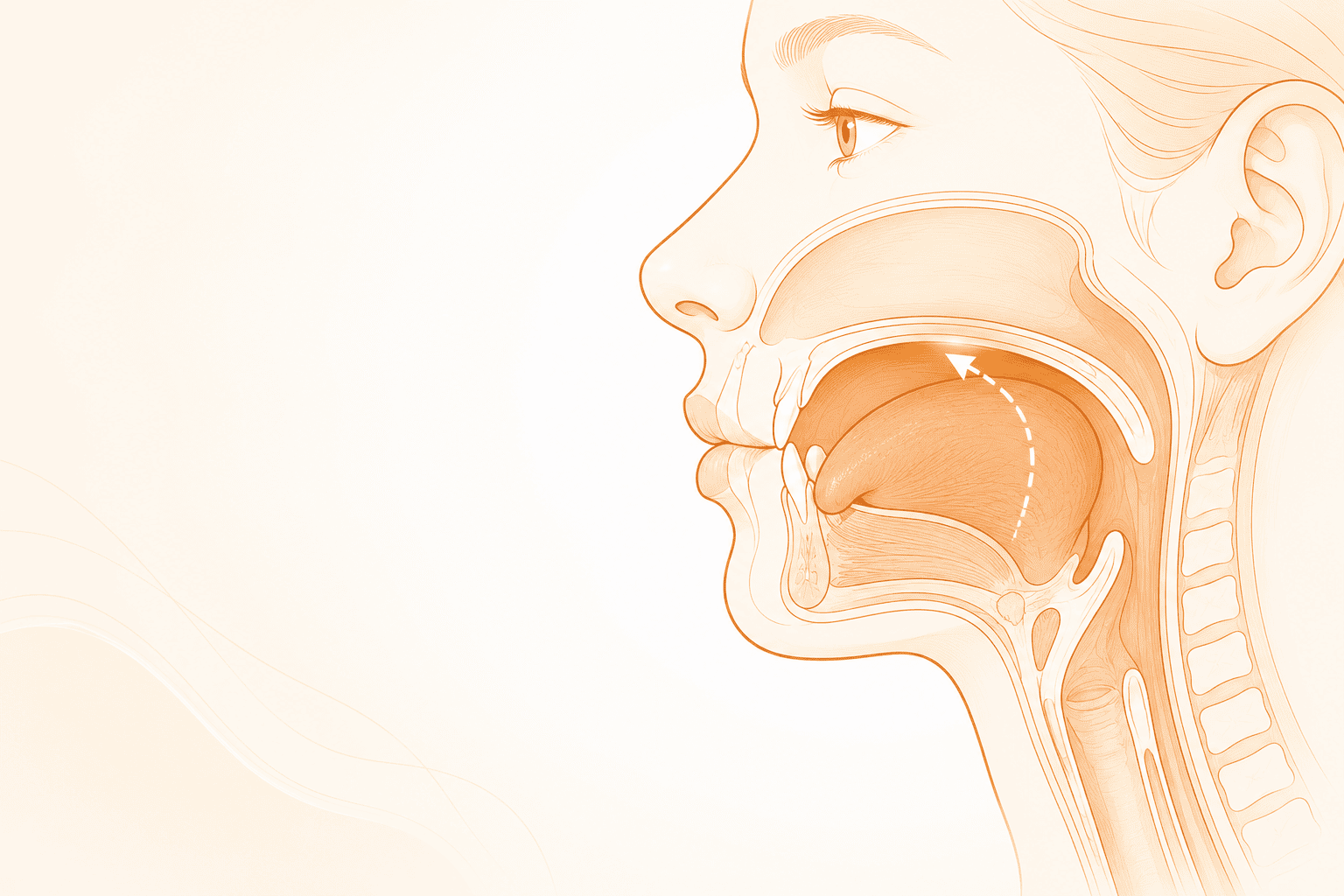
Five tongue exercises — from myofunctional therapy, sequenced for daily practice — that build the resting posture your speech, sleep, and swallow all depend on. Two to five minutes a day. That's the training window.
These aren't warm-up tongue twisters. They're the neuromuscular baseline drills that pediatric SLPs and myofunctional therapists use as Phase 2 of an evidence-based protocol. Do them consistently and rest posture becomes autonomous over 6-12 weeks.

Why These Five, In This Order
Myofunctional therapy protocols organize tongue-posture work into stages: awareness, isolation, endurance, integration, and carryover. These five exercises walk that arc in miniature. Do them in order. Skip stages and the pattern doesn't hold.
The goal is not tongue strength for its own sake. It's building the neuromuscular default so that when your mind wanders, the tongue defaults to the palate — not the floor of the mouth. That's the "spot" that changes speech, breath, and sleep at once. Full tongue posture guide →
Exercise 1 — The Spot
Why it's first: awareness. Most people can't feel where the tongue is supposed to live until they've located the exact spot.
How: Close your mouth. Say the letter "N" — hold it for two seconds. The place your tongue tip presses on the roof of your mouth is the spot. That bumpy area just behind your upper front teeth (the alveolar ridge) is where the tongue tip should live at rest. Practice locating it 10 times in a row, holding each for 3-5 seconds.
Frequency: 10 reps, 2× daily. Do this for the first 3-5 days before adding Exercise 2.
Exercise 2 — Whole-Tongue Suction
Why it's second: isolation. Locating the spot is one thing; sealing the entire tongue against the palate is another.
How: With mouth closed and lips lightly together, suction the entire tongue up to the roof of the mouth so it presses along the whole palate. Hold 5 seconds. Release. Repeat 10 times. You should feel the sides of the tongue touching the upper molars.
Frequency: 10 reps, 2× daily. Add this once Exercise 1 feels effortless.
Exercise 3 — Click & Hold
Why it's third: endurance. This one builds the tongue's stamina to hold posture for longer stretches.
How: Suction the tongue against the palate (like Exercise 2), then quickly release it downward to create a "click" sound. Immediately re-suction and hold for 10 seconds. Repeat 5 times. You're training the tongue to find the palate quickly after any disruption — chewing, swallowing, speaking.
Frequency: 5 reps, 2× daily. Add this in week 2.
Exercise 4 — Swallow-With-Spot
Why it's fourth: integration. You swallow ~1,000 times a day. If each swallow reinforces low tongue posture, the exercises are working against the swallow. This drill flips it.
How: Take a small sip of water. Before swallowing, place the tongue tip firmly against the spot behind the upper front teeth. Keep the tip planted while you swallow. The rest of the tongue should lift up and back — not push forward against the teeth. Practice 5 conscious "spot swallows" per meal.
Frequency: 5 conscious swallows per meal, 3 meals/day. Add this in week 3-4. This one is the biggest lever on carryover.
Exercise 5 — Passive Hold With Anchor
Why it's fifth: carryover. The prior four are active drills. This one is passive — you're building the rest-posture default that runs while you're not thinking about it.
How: During reading, screen time, or focused work, place the tongue on the spot and let it rest there. Don't consciously press — just place and forget. Every time you notice the tongue has dropped, gently return it. This is where Adult Spot Pal becomes valuable — it gives the tongue a tactile "spot" to home against passively, without requiring active concentration. 30-60 minute stretches during quiet work.
Frequency: 30-60 minutes daily, ongoing. This is the layer that produces autonomous rest posture over 6-12 weeks. Deeper practical exercises →
"I did these five exercises exactly as written — three minutes in the morning, three minutes at night. Six weeks in my dentist noticed my palate had widened slightly at cleaning. Ten weeks in my husband stopped complaining about my snoring. I wasn't targeting either of those. Just did the drill."
Common Questions
Do I need Spot Pal to do these exercises?
The first four exercises are exercise-only — no appliance required. Exercise 5 (Passive Hold) is where Spot Pal makes the difference. Without an anchor, most adults can't hold rest posture passively for 30-60 minutes; they consciously place the tongue, get distracted, and lose it. The tactile "spot" of the appliance makes passive hold sustainable, which is what actually drives carryover.
Can I do these exercises with braces or aligners?
Yes for all five — braces and aligners don't interfere with tongue exercises. If anything, orthodontists increasingly recommend myofunctional exercises as an adjunct to reduce post-treatment relapse. Coordinate with your orthodontist if you're using Spot Pal for Exercise 5.
How long before I notice a change?
Awareness of the "spot" — where your tongue is supposed to live — usually emerges in the first week. Habitual mouth-closed rest posture at 4-6 weeks. Downstream markers (sleep quality, speech clarity, morning jaw feel) at 8-12 weeks. Consistency matters more than intensity.
Are these appropriate for kids?
Ages 5+, yes, though kids benefit most from doing them with parent guidance and a pediatric myofunctional therapist's oversight. Below age 5, exercise-only pediatric protocols are gentler and more play-based. Read our kids-parent guide for age-appropriate framing.
What if my tongue is too tight or too weak to do Exercise 2?
If the whole-tongue suction is hard even after a few days of practice, tongue mobility may be limited — sometimes by a tight lingual frenulum (tongue tie). This warrants evaluation by a myofunctional therapist or SLP trained in orofacial myofunctional assessment. The exercises are still useful preparation, but full carryover may require the underlying restriction to be addressed first.
Keep reading
Share:
5 Signs of Sleep Apnea
5 Breathing Exercises (with a Spot Pal)