

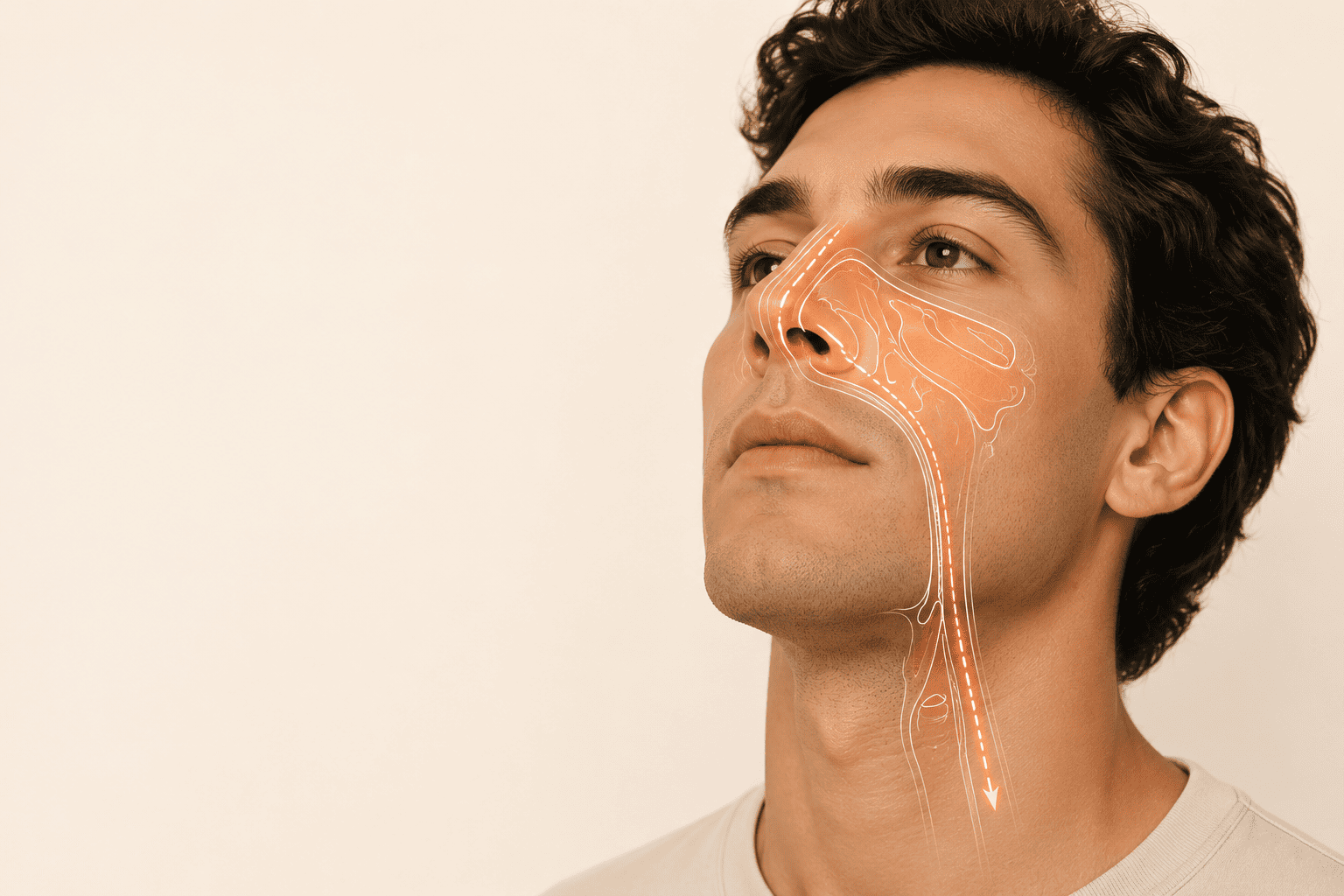
Your mouth was never supposed to be your primary airway. Your nose was.
Mouth breathing looks harmless, feels normal, and quietly reshapes how you sleep, how you recover, and how your face developed as a child. Here's the complete guide — what it is, why nasal wins, and how to retrain the pattern in two to five minutes a day.

What Is Mouth Breathing?
Mouth breathing is exactly what it sounds like — drawing air in and out through the mouth rather than the nose. It looks harmless. Most adults do it without noticing. That's the problem: the mouth is a backup airway, not the default. When it becomes the default, the whole respiratory system compensates.
Nasal breathing does at least four things the mouth simply can't:
- Filters the air. Nasal hairs (vibrissae) and mucus catch particles, allergens, and pathogens before they hit the lungs.
- Humidifies and warms it. By the time inhaled air reaches the alveoli, it's at body temperature and near 100% humidity — reducing airway irritation and inflammation.
- Produces nitric oxide. The paranasal sinuses release nitric oxide during nasal breathing, which relaxes the airways and increases oxygen uptake by ~10-15%. Mouth breathing skips this entirely.
- Regulates CO2 tolerance. Nasal breathing is slower and deeper by design. Mouth breathing tends to be shallow and fast, which flushes CO2 too aggressively and destabilizes the breathing pattern over time.
Mouth breathing gets started somewhere — chronic allergies, a childhood adenoid issue, a deviated septum, or (most commonly) tongue posture that doesn't seal the palate — and then the habit sticks. The mouth becomes the primary route by default. Nasal breathing collapses first at night, when the mouth falls open during sleep. Then it starts to collapse during the day too. Over years, this is what remodels the face, the airway, and the sleep pattern.
Mouth breathing is a habit, not a personality. Habits are trainable — but only if you first know it's happening.
Signs You're Mouth Breathing (Even If You Don't Realize It)
Most adults who mouth-breathe never catch themselves doing it in real time. What they notice is downstream: symptoms that seem unrelated but track back to the same cause.
You wake up with a dry mouth.
Reaching for water first thing in the morning is a signal, not a preference. Nasal breathers wake up with saliva; mouth breathers wake up parched.
You snore or breathe audibly at night.
A partner will often notice this before you do. Nasal breathing is quiet. Mouth breathing under sleep muscle relaxation gets loud.
You wake up already tired.
Eight hours of shallow, mouth-open breathing does not equal restorative sleep. The nervous system never fully drops into parasympathetic recovery.
You catch yourself with your mouth open.
Scrolling on your phone. Watching TV. Concentrating at your desk. Lips parted at rest is the daytime version of the nighttime pattern.
The Five Systems Mouth Breathing Wrecks
Mouth breathing doesn't stay local to the airway. When it becomes the default, five downstream systems degrade — often quietly enough that they get chalked up to age, stress, or "just how I am."
1. Sleep quality and recovery
Mouth breathing during sleep produces shallow, fast respiration. That fragments sleep architecture — less deep sleep, less REM, more micro-arousals the brain doesn't consciously register. The result is the "eight hours but still tired" pattern that so many adults recognize. Deep dive on mouth breathing and sleep quality →
2. Immune function and inflammation
The nose filters, humidifies, and warms air before it hits the lungs. Skip that step, and everything downstream — throat, sinuses, lungs — is dryer, more irritated, more prone to catching what's going around. Chronic mouth breathers report more colds, more sinus infections, more inflammation. It's not incidental. Related: sleep apnea and airway health →
3. Facial and palate development (children)
In growing children, mouth breathing reshapes the face itself. A tongue that isn't sealing against the palate — because the mouth is open to breathe — can't widen the arch. The palate narrows. Teeth crowd. Facial growth trends longer and narrower rather than forward and balanced. This is why pediatric dentists and orthodontists increasingly screen for mouth breathing during routine visits. For parents: the health risks of mouth breathing →
4. Athletic performance and endurance
Nasal breathing supports higher CO2 tolerance and better oxygen uptake per breath. Athletes who mouth-breathe under load drop into shallow chest breathing, stack CO2 inefficiently, and gas out earlier. This is why combat, endurance, and high-rep sports coaches increasingly train nasal breathing under exertion. Athlete lander: nasal breathing under load →
5. Tongue posture, jaw, and postural chain
You can't mouth-breathe with the tongue sealed against the palate. So chronic mouth breathing forces the tongue to rest on the floor of the mouth — which then destabilizes the jaw, promotes forward-head posture, and chains down through the neck into the shoulders and ribs. Mouth breathing and low tongue posture are two symptoms of the same underlying pattern. Tongue posture: the complete guide →
How To Retrain Nasal Breathing
Nasal breathing is trainable at any age. It's not a technique you master in a weekend — it's a habit rewire that compounds over eight to twelve weeks with daily practice. The mechanics are simple.
Step 1 — Awareness first.
For one week, set five phone reminders through the day: check your mouth. Is it open or closed? Are you breathing through your nose or your mouth right now? Most people are astonished by how often the answer is "mouth" — because they've never noticed. That astonishment is the point. The habit runs unconsciously; you have to make it conscious to change it.
Step 2 — Daytime nasal-first practice.
Whenever you're not talking, eating, or under maximum exertion, close your mouth. Breathe through your nose. That's it. If your nose feels blocked or effortful, that itself is a sign — most mouth breathers have congested-feeling noses because they never use them at full capacity. The tissue will re-open with consistent use over two to four weeks.
Step 3 — Nighttime protocol.
Nighttime is harder because you can't consciously enforce a habit while asleep. The goal is to bias the body toward nasal breathing before you fall asleep, so the pattern holds through the night. That means: elevate the head of the bed slightly, breathe through your nose deliberately for the first ten minutes of lying down, and train the tongue-palate seal during the day so it holds at night. See five breathing exercises with a Spot Pal for specific drills.
Step 4 — A physical target for the tongue.
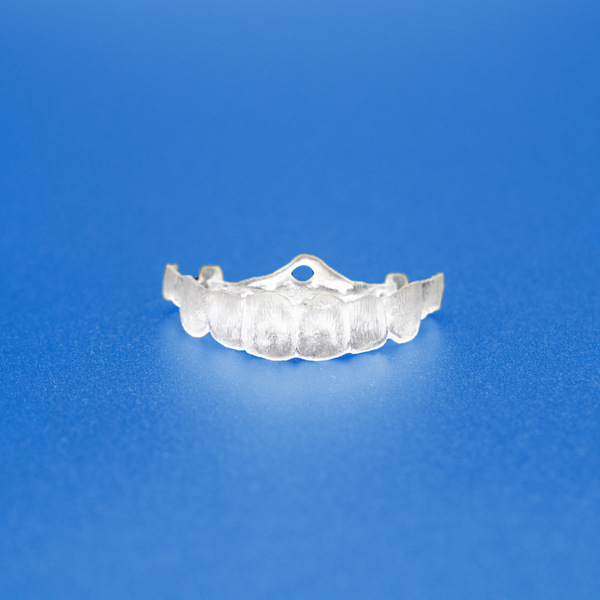
This is where Spot Pal works. It's a patented custom-fit tongue training appliance with a tactile cue — the tongue locks against the palate around a physical landmark. Two to five minutes a day. When the tongue holds the seal, the mouth closes by default, and nasal breathing becomes the path of least resistance. Awareness alone gets you partway. Spot Pal shortens the timeline because the mechanism is built into the device.
Ready to train? The Adult Spot Pal ships with a custom-fit kit and a guided video program. Two to five minutes a day, 30-Night Trial.
Shop Adult Spot Pal · $229Common Myths About Mouth Breathing
"I have to mouth-breathe because my nose is blocked."
Sometimes true, more often not. Chronic mouth breathers develop a feeling of nasal blockage because the tissue isn't being used at full flow. Two to four weeks of consistent nasal breathing typically re-opens the passage. If you have a diagnosed deviated septum, chronic sinusitis, or severe allergies, work with an ENT in parallel — but don't assume the blockage is permanent without checking.
"Mouth breathing during exercise is fine."
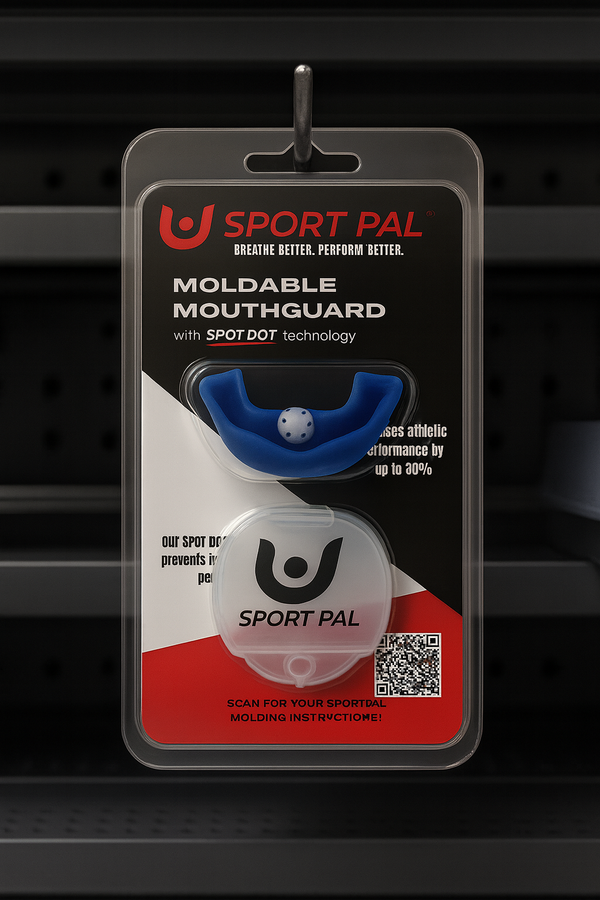
At maximum exertion, everyone mouth-breathes eventually — that's built in. The issue is defaulting to mouth breathing at moderate loads, when nasal breathing is still viable. Athletes who train nasal-first for as long as possible before switching improve CO2 tolerance and endurance in ways that mouth-breathers can't. That's the athletic edge Boil & Bite Sport Pal is designed around.
"It's just cosmetic — my snoring doesn't hurt anything."
Snoring is the audible signal that the upper airway is partially obstructing during sleep. Chronic snoring correlates with reduced sleep quality for both the snorer and their partner. If snoring is loud, patterned, or paired with gasping / choking / daytime fatigue, get evaluated for sleep apnea — but treat the underlying pattern (tongue posture, mouth breathing) regardless.
"I've been a mouth breather my whole life — I didn't know that was even a thing you could 'fix.' I'd wake up dry, foggy, exhausted, and just chalked it up to bad sleep. Six weeks with Spot Pal and I stopped waking up dry. My wife noticed the snoring changed before I did. Small stuff. But it added up to sleeping like an adult for the first time in years."
Pick The Right Spot Pal


Common Questions
Is mouth breathing actually a health problem?
Chronic mouth breathing is associated with reduced sleep quality, higher rates of dry mouth and gum inflammation, narrower palate development in children, forward head posture, and reduced CO2 tolerance during exertion. Occasional mouth breathing under maximum load isn't a concern — defaulting to it at rest and during sleep is.
Can adults actually switch back to nasal breathing?
Yes. Nasal breathing is a habit maintained by muscle memory and tongue posture — habits are trainable at any age. Most adults report noticeable change in two to four weeks of consistent daily practice, and full habit shift by eight to twelve weeks. The tissue itself adapts to the increased airflow over the same window.
What if my nose feels blocked when I try?
A feeling of blockage is common at the start — the nasal tissue hasn't been used at full flow in years and needs to re-open. Consistent nasal breathing typically clears this in two to four weeks. If congestion is severe, persistent, or paired with pain or discharge, see an ENT to rule out anatomical issues.
Do I need a specialist to fix mouth breathing?
Not for the training itself — awareness, tongue posture, and daily exercises are self-directed. Work with a professional in parallel if you have diagnosed sleep apnea, chronic sinus issues, an in-progress orthodontic case, or if a child is mouth breathing (pediatric dentists and SLPs screen for it during routine care).
How is Spot Pal different from other approaches?
Most nasal-breathing methods rely on awareness and effort alone. Spot Pal adds a physical target — a patented custom-fit device with a tactile cue that keeps the tongue against the palate. When the tongue seals, the mouth closes by default and nasal breathing becomes the path of least resistance. It's habit training with a built-in mechanism, not a trick.
Should my child use one if they mouth-breathe?
If your pediatric dentist or SLP has flagged mouth breathing, tongue thrust, or narrow palate development, Spot Pal Mini (ages 2-4) or Junior (ages 5-12) is designed for exactly that use. Early habit shift matters — palate development is most responsive during the growth years. Work alongside your child's clinician for the best result.
Share:
Tongue Posture: The Complete Guide
Athletic Performance: The Complete Guide