

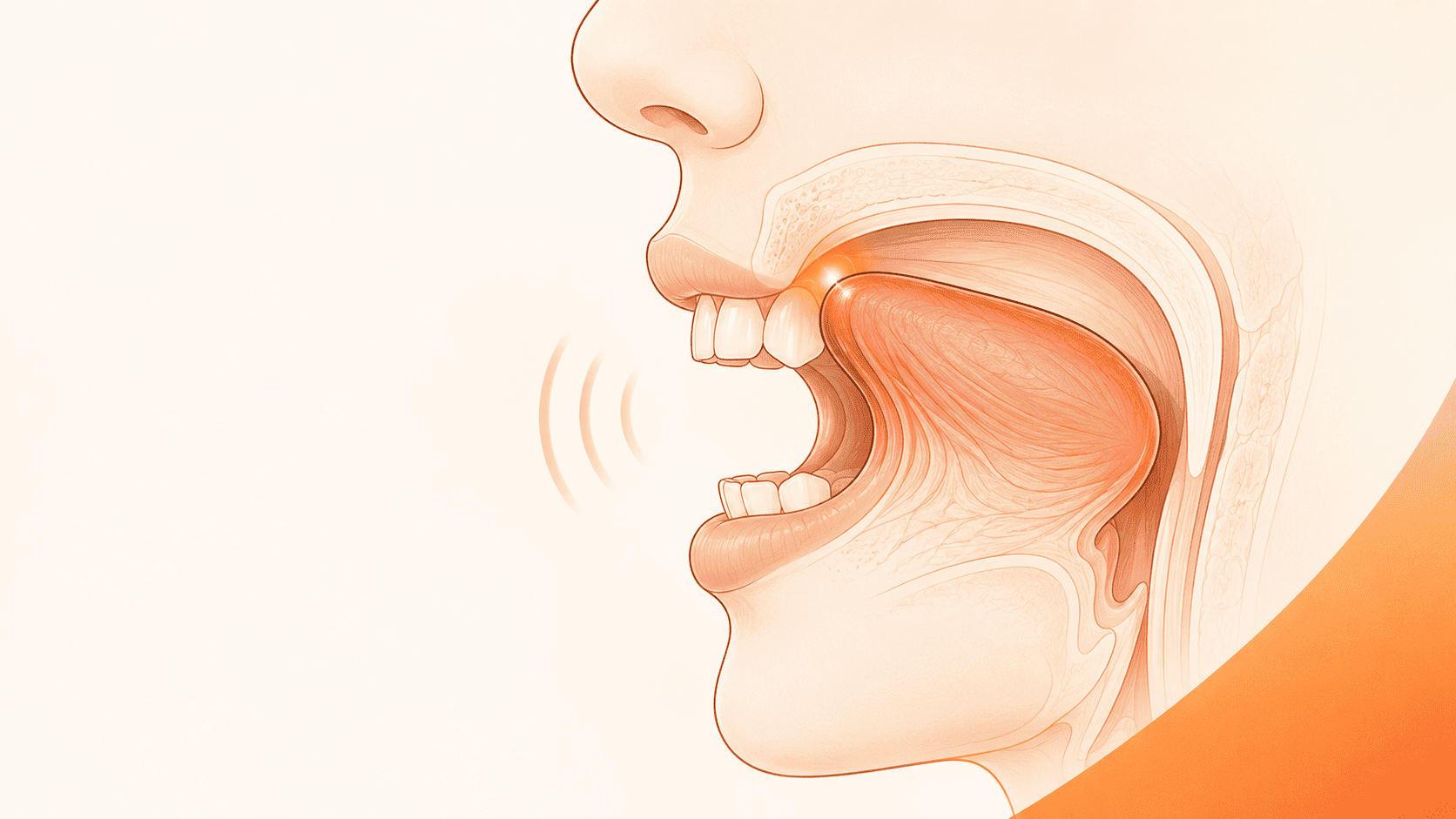
Articulation drills work — when they hit the sound the way an SLP would target it, and when they're paired with the underlying resting-posture work that makes the sound stick. Here are the practical exercises therapists actually use, mapped to /s/, /r/, /l/, /th/, and sequenced for daily practice.
Two to five minutes a day per targeted sound. Works for kids ages 5+ and adults with residual carryover. Paired with a patented resting-posture appliance for the substrate.

Before The Exercises — The Substrate Rule
Articulation drills alone often stall. Not because the drills are wrong — because the tongue keeps defaulting back to the wrong resting position between attempts. If the tongue lives in the floor of the mouth at rest, every drill has to start by finding the palate. That's an extra step of work per rep, and it's why sounds emerge in the SLP office but regress in conversation.
Solving this looks like two parallel tracks:
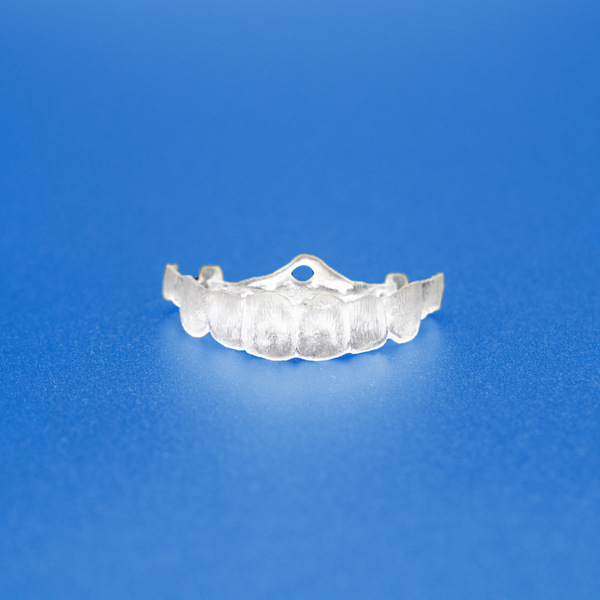
- Rest-posture retraining — passive daily work with a patented resting-posture appliance like Spot Pal for Speech (or Spot Pal Junior for kids, Adult Spot Pal for adults). 30-60 minute stretches during quiet activities.
- Sound-specific drills — the exercises below, sequenced from awareness to isolation to conversation.
Doing both simultaneously is what makes the sound generalize. Doing only drills often plateaus. Tongue posture pillar →
Exercises For /s/ and /z/ (Interdental Lisp)
/s/ requires a stable tongue tip against the alveolar ridge (bumpy spot behind upper front teeth), with air channeled down the midline of the tongue. Interdental lisps happen when the tongue tip protrudes forward.
Butterfly position drill
Smile wide (teeth showing lightly), then position the tongue tip just behind the upper front teeth without touching them. Practice saying "iss" holding this position — the /s/ emerges from air flowing over the tongue, not through it. 10 reps, 2× daily.
Long-S hold
With tongue in butterfly position, produce a sustained /sssss/ for 5-8 seconds. If it wavers or drifts to /th/, reset and try again. Builds endurance and stability in the target position. 5 reps.
Word-level carryover
Say "sun, seven, sit, city, mouse, house" — 10 words at a time, focused on maintaining the position across each word. Progress to phrases when word-level is clean.
Exercises For /r/ (One of the Hardest Sounds)
/r/ has two production styles: retroflex (tongue tip curled back and up) and bunched (tongue body bunched toward the palate). Different kids find different styles work — often trial-and-error with an SLP.
Growl-and-hold
Produce a low "grrr" sound with the tongue lifted somewhere in the back of the mouth (bunched or retroflex — whichever emerges). Hold 3 seconds. This isolates the correct tongue-body position without the added complexity of vowels or blends. 5 reps.
Vocalic-R minimal pairs
"Bear/beer, hair/here, star/store" — pairs that isolate the /r/-colored vowel. Say each pair 5 times with clean tongue position. Vocalic /r/ is often the hardest carryover target.
Conversation-context drills
Read a paragraph aloud with /r/ words highlighted. Say each highlighted word with intention, letting the surrounding conversation flow normally. This is generalization work — where most /r/ therapy plateaus without it.
Exercises For /l/
/l/ needs the tongue tip against the alveolar ridge with the sides of the tongue relaxed. Kids often produce /w/ substitutions (yellow → "yewwow") because the tongue tip drops.
Tip-tap drill
Tongue tip taps the alveolar ridge — 10 rapid taps in a row while making a "la la la" sound. Isolates the tip-alveolar contact that's the anatomical foundation of /l/. 3 sets of 10.
Long-L hold
Sustain /lll/ for 5-8 seconds with the tongue tip anchored on the alveolar ridge. Check in a mirror — if the lips round or the tongue drops, reset. Builds sustained tongue-tip control.
Exercises For /th/ (Voiced and Voiceless)
/th/ is naturally interdental — the tongue tip lightly between the front teeth. What kids often do wrong is substitute /f/ or /d/. The exercises teach the correct light-contact position.
Peek-a-tongue
Stick tongue tip out slightly (peeking between teeth), blow air gently over it. The voiceless /th/ (as in "think") emerges. Add voice for the voiced /th/ (as in "this"). 10 reps each, 2× daily.
Contrast drill: F/TH/S
Alternate "fin-thin-sin, four-thaw-saw, fought-thought-sought" — trains the child (or adult) to distinguish the three related sound positions. Contrast is how ambiguity gets resolved. Tongue thrust guide →
How To Sequence These Exercises
Don't do all four sounds at once — that overwhelms the practice window and dilutes focus. Sequence by picking the primary target sound (from an SLP evaluation) and drilling it 5-8 minutes daily. Add secondary sounds only after primary is stable.
- Weeks 1-2: Awareness + isolation drills for the primary sound.
- Weeks 3-4: Word-level carryover for the primary sound.
- Weeks 5-6: Phrase and sentence-level for the primary sound.
- Weeks 6-8: Conversation-level generalization for the primary sound. Introduce secondary sound at this stage if warranted.
Throughout: passive rest-posture work with the patented Spot Pal appliance during 30-60 minute quiet windows daily. This is the substrate that makes the drill work stick. Speech development pillar →
"I'm an SLP. I've been giving families this basic exercise structure for years. What's changed with adding a patented resting-posture appliance to the recommendation is that carryover happens faster. Families used to get to weeks 8-10 for /s/ generalization. Now we routinely see it at weeks 4-6 because the substrate is being retrained in parallel."
Common Questions
Can I do these exercises without an SLP?
For general awareness and mild issues, yes. For diagnosed articulation disorders in kids or persistent adult carryover, working with an SLP significantly improves outcomes because they can catch subtle production errors, structure the drill sequence, and correct compensatory patterns before they lock in. These exercises complement professional care.
How long before I see change?
Sound-level improvement within 2-4 weeks of consistent daily practice. Word-level generalization at 4-6 weeks. Conversation-level generalization at 6-10 weeks. Adult carryover typically runs slower — 3-6 months for full generalization. Kids move fastest when rest-posture work is done in parallel.
Do I need Spot Pal for these to work?
The exercises are exercise-only. Spot Pal is separately valuable for the substrate work that makes the drills stick faster. Many families use the exercises alone and see progress; adding the patented resting-posture appliance typically compresses the timeline meaningfully by retraining the underlying resting tongue position between drills.
Are these exercises for kids or adults?
Both. The mechanics of /s/, /r/, /l/, /th/ production don't change with age — only the timeline and the pairing appliance do. Kids use Spot Pal Junior; adults use Adult Spot Pal or Spot Pal for Speech. The exercises themselves are the same.
What if my child resists the practice?
Common. Short daily windows (5 minutes) with playful framing work better than long sessions. Turn drills into games. Use rewards. Pair with something they enjoy (reading a favorite book aloud). If resistance is strong, an SLP can restructure the approach — sometimes just changing the setting or timing unlocks compliance.


Share:
Adults With Residual Speech Errors — Where To Start
CO2 Tolerance Training: What Endurance Athletes Miss