

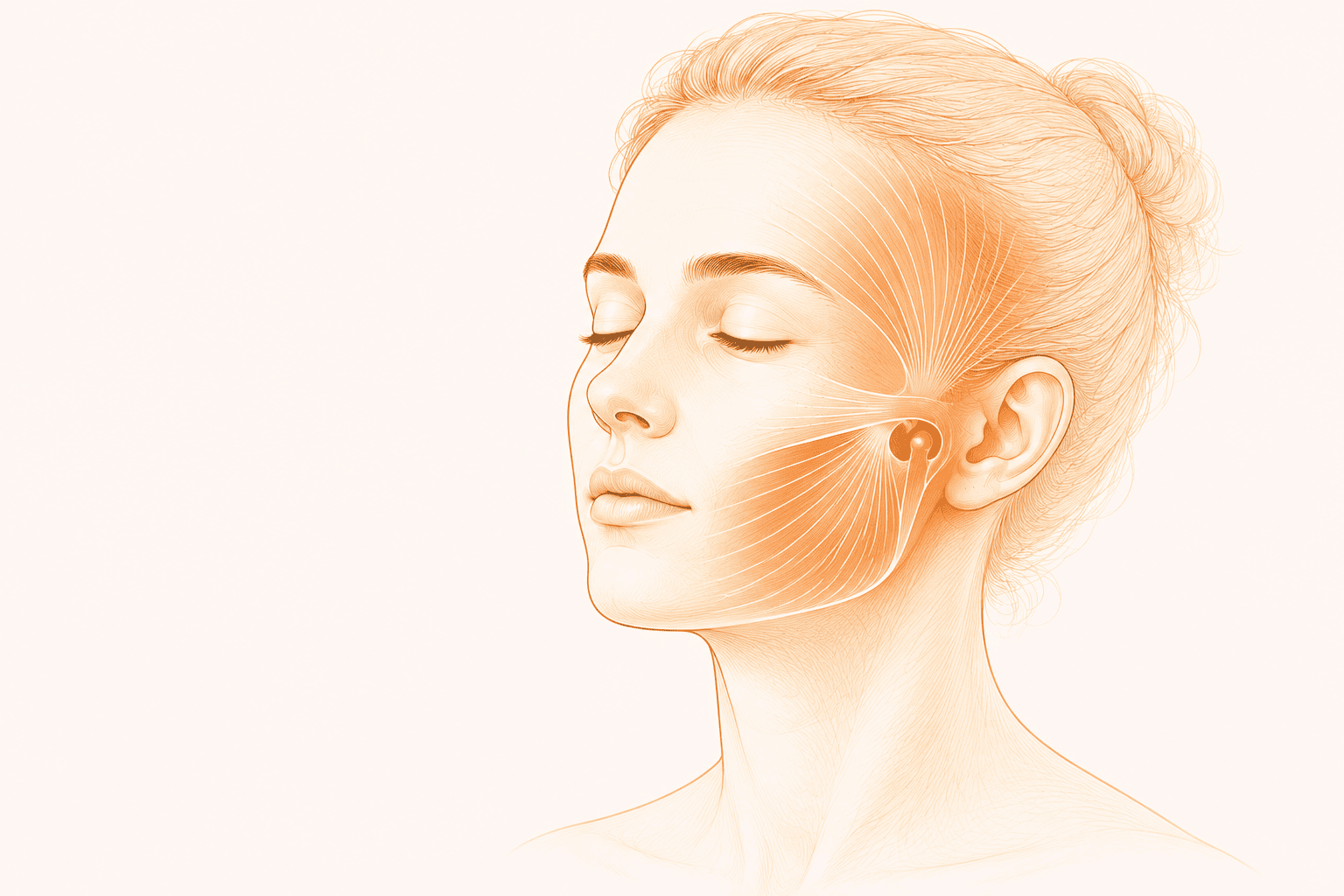
Most TMJ workups treat the symptoms — the jaw pain, the headaches, the clicking. What they rarely address is the mechanism driving the pattern: tongue posture, airway compromise, and the compensatory clench that ties them together.
Here's a complete clinical overview of TMJ disorders — the causes, the symptoms, the treatment landscape, and where the patented resting-posture protocol from Spot Pal fits into a real cause-directed approach.

What TMJ Disorders Actually Are
Temporomandibular joint disorders (TMD) is the umbrella term for a range of conditions affecting the joint that connects your jaw to your skull. It's one of the most-used joints in the body — every chew, every swallow, every word cycles it — so when it's dysfunctional, the impact is everywhere.
Clinical categories generally break into three:
- Myofascial pain. Muscle-driven — the muscles around the joint (masseter, temporalis, pterygoids) are chronically overworked or tender. The most common presentation.
- Internal derangement. The disc inside the joint is displaced. Presents as clicking, popping, or locking when the jaw opens.
- Degenerative or inflammatory joint disease. Arthritis, systemic inflammatory conditions, or joint surface breakdown. Requires imaging and often specialist care.
Most TMJ cases fall in the first bucket — myofascial pain. And most of that bucket has an upstream driver that a conventional workup doesn't formally screen for: how the tongue and jaw are posturing when nobody's looking. TMJ pillar with full mechanism →
Common Symptoms
TMJ presents in dozens of ways — often not obviously "jaw" symptoms.
Jaw pain and tenderness.
Ache in front of ears, along the jawline, or in the temples. Often worse in the morning after a night of clenching.
Clicking, popping, or grinding sounds.
Audible when opening or closing the mouth. Signals disc displacement or joint surface changes.
Chronic headaches.
Tension-type headaches, especially frontal and temporal. Morning headaches are strongly linked to nighttime bruxism.
Ear pressure, ringing, or fullness.
The TMJ shares fascia with the middle ear. Referred pressure and tinnitus are classic TMJ markers.
Neck and shoulder tension.
The mandible articulates through the cervical spine. TMJ patients often have upper-back tension PT alone can't unwind.
Difficulty chewing or opening wide.
Limited range of motion, pain on hard foods, jaw fatigue during meals.
What Causes TMJ Disorders
TMJ is multifactorial. Rarely one cause. Most cases have two or three contributing drivers overlapping:
1. Chronic clenching and grinding (bruxism).
The most common cause. Nighttime bruxism is often airway-protective — the jaw is being recruited to hold the airway open when the tongue-palate seal breaks. Daytime clench is usually low-tongue-posture compensation. Both accumulate load on the joint. Full teeth grinding guide →
2. Low resting tongue posture.
When the tongue doesn't seal the palate at rest, the jaw does structural work the tongue-palate seal should do. That compensation, held hours a day, is the mechanical origin of chronic myofascial TMJ pain. Addressing this — with the patented Adult Spot Pal or with myofunctional therapy exercises — targets the driver directly.
3. Airway compromise.
Mouth-open sleep drops the jaw and retracts the tongue, narrowing the pharyngeal airway. The nervous system's compensation — clenching forward to protect airway patency — presents clinically as bruxism. TMJ and airway compromise are often the same pattern from two clinical vantage points. Mouth breathing pillar →
4. Trauma or injury.
Whiplash, sports impact, dental procedure trauma, or a direct blow to the jaw can precipitate TMJ symptoms. Trauma-onset cases often require different first-line care and warrant orofacial pain specialist referral.
5. Systemic conditions.
Rheumatoid arthritis, lupus, fibromyalgia, and other systemic inflammatory conditions can present with TMJ involvement. These require primary treatment of the underlying condition. Hidden causes of TMJ →
Treatment Landscape
Treatment options range from conservative to surgical. Most TMJ cases respond to conservative care done well.
Nightguards.
Custom-fit soft nightguards like Night Pal protect the teeth from active bruxism. This is layer 1 of a real protocol — non-optional if grinding is present. Prevents enamel damage while upstream work is emerging.
Daytime rest-posture retraining.
This is the layer most standard TMJ workups skip. Adult Spot Pal is a patented resting-posture appliance that trains the tongue-palate seal — the mechanical variable that keeps the jaw off structural duty. Worn 30-60 min during focused work.
Physical therapy & massage.
PT can significantly reduce myofascial pain and restore range of motion. Pairs powerfully with rest-posture retraining — PT unwinds the tension; posture correction stops the pattern from resetting it.
Medication (short-term).
NSAIDs for acute pain. Muscle relaxants for severe spasm. Botox in specific cases. All are short-term buffers — not long-term solutions.
Specialist referral.
Orofacial pain specialists and oral surgeons are the appropriate referral for locked jaw, progressive facial asymmetry, disc displacement without reduction, or systemic joint disease. Myofunctional therapy as TMJ modality →
"Nine months of nightguards and PT — some relief but never resolution. My oral surgeon actually asked how my tongue rested. When I said 'in the bottom of my mouth,' he said 'that's your problem.' Started wearing Adult Spot Pal during work hours plus continued PT. Four months later my morning pain is a fraction of what it was."
Common Questions
Is TMJ permanent?
Most myofascial TMJ (the common form) is not permanent — it's a functional pattern that responds to conservative treatment done well. Cases involving disc displacement, systemic inflammatory disease, or structural joint changes may have permanent components requiring specialist care, but even those often stabilize with proper treatment.
How long does treatment take?
Individual variation is significant. Most patients report initial symptom improvement within 4-8 weeks of a layered protocol (nightguard + rest-posture retraining + PT). Full resolution or stable long-term reduction usually settles at 3-6 months. Traumatic-onset cases and long-standing chronic cases typically move slower.
Should I get an MRI or CT scan?
Not typically first-line. Imaging is warranted if there's locked jaw, progressive asymmetry, suspected disc displacement without reduction, or lack of response to 3+ months of appropriate conservative care. Your dentist, orofacial pain specialist, or oral surgeon determines when imaging is indicated.
Is Botox worth trying?
Masseter Botox reduces the force of clench — it can meaningfully reduce headaches and pain for some patients, but effects last only 3-4 months and it doesn't address the driving pattern. Consider it a buffer while cause-directed protocol runs, not a standalone solution.
Can kids get TMJ?
Yes. Pediatric TMJ often presents as headaches, morning jaw soreness, or popping. Common in kids with mouth-breathing patterns and low tongue posture. Because palatal shape is still developing in this age group, early myofunctional intervention is disproportionately valuable. Pediatric myofunctional therapist referral is the standard first step.
What's the connection between TMJ and sleep?
Well-documented. Mouth-open sleep drops the jaw and retracts the tongue, narrowing the airway. The nervous system's protective clench response presents clinically as bruxism — driving TMJ pain. Patients with both TMJ symptoms and disrupted sleep should have both evaluated together. Sleep study is warranted if snoring, morning fatigue, or witnessed apneas are present.
Share:
How to Retrain Nasal Breathing: An 8-Week Progression
Signs Your Child Has Tongue Thrust