

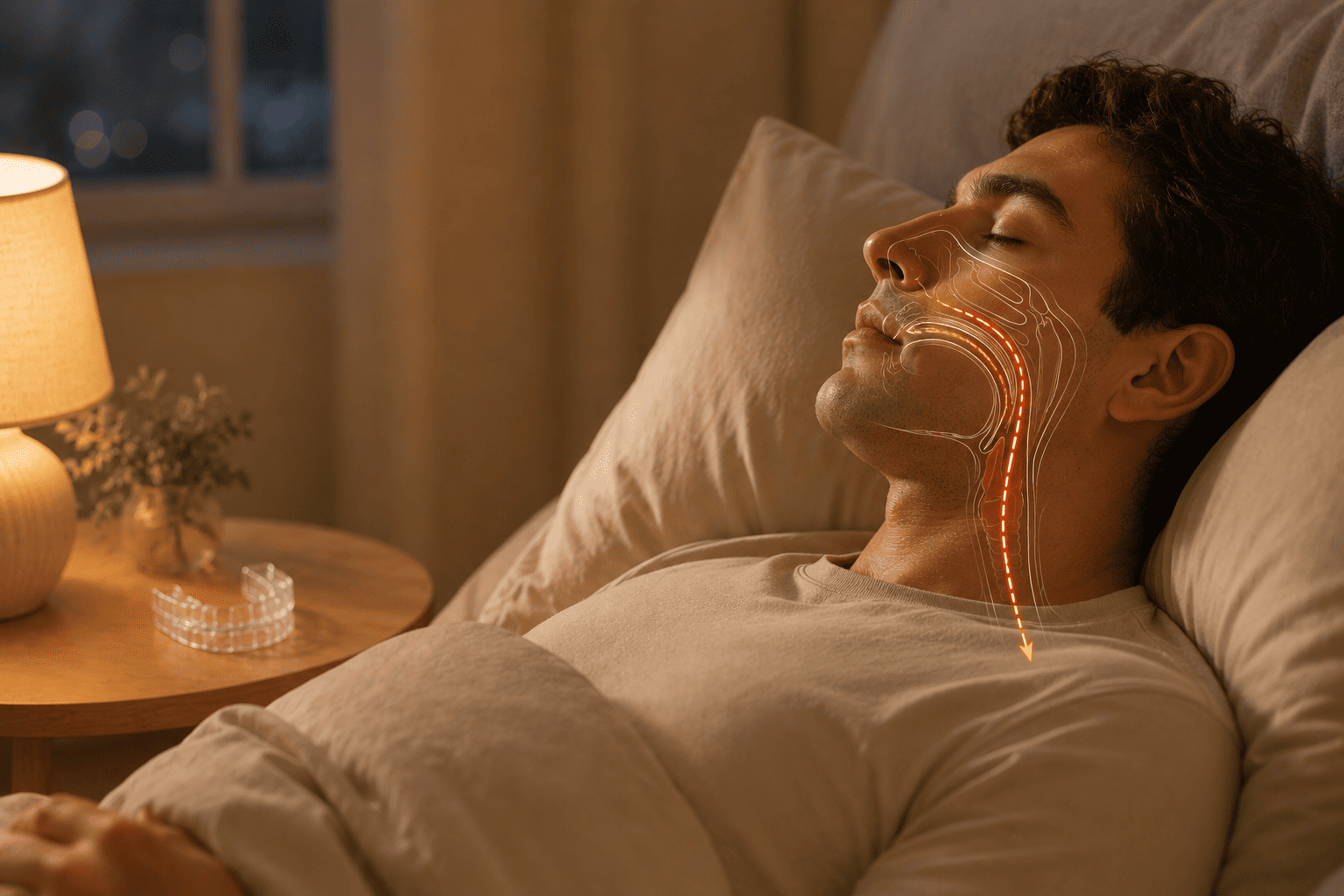
Sleep is a downstream signal, not an upstream cause. When it's broken — snoring, morning fatigue, jaw pain, waking unrefreshed — the fix isn't better sleep hygiene. It's better airway.
The tongue, the palate, and the jaw run the airway all night. When those aren't posturing correctly, the eight hours you spend in bed stop rebuilding you. Here's the clinical breakdown — and the layered protocol that resolves the cause.

What Sleep Hygiene Misses About Sleep
Sleep hygiene guidance is real — dark rooms, cool temperatures, no screens, consistent bedtimes. All of it helps. What it doesn't address is the reason someone spends eight hours in bed and wakes up already tired.
The variable most sleep advice skips is what your airway is doing while you sleep. Between the moment your eyes close and the moment they open, three structures are running the show:
- The tongue. If it's sealed against the palate, the base of the tongue pulls forward — keeping the airway open. If it's dropped into the floor of the mouth, it slides back — narrowing or partially blocking the airway.
- The palate. The soft palate at the back of the mouth is what vibrates when you snore. What determines whether it vibrates is how much airflow is being forced through a compromised space — and how much space the tongue has left it.
- The jaw. A relaxed, dropped jaw at night pulls the tongue back and lets the mouth fall open. Mouth-open sleep bypasses the nose, skips nitric oxide, and dries out the airway.
Every downstream sleep signal — snoring, morning fatigue, jaw pain, dry mouth, waking-up-heart-racing, unrefreshed sleep despite eight hours — traces to one or more of those three variables not doing their job. How mouth breathing affects sleep quality →
Six Signs Your Airway Isn't Doing Its Job At Night
Not every sleep issue is airway-driven — some are circadian, some are hormonal, some are psychiatric. But if two or more of these are present, airway assessment should be on the list before deeper interventions.
You snore — even sometimes.
Snoring is the sound of air being forced past a partially collapsed airway. Occasional snoring means your airway is at the margin; nightly snoring means it's compromised.
You wake up with a dry mouth.
Dry mouth means you slept with your mouth open. Mouth breathing all night skips nasal humidification and bypasses nitric oxide.
Morning jaw fatigue or tension headaches.
Waking with sore temples, tight masseters, or a dull frontal headache is the daytime signal of a night-clench pattern — often airway-protective bruxism.
Eight hours in bed, still tired.
Adequate time-in-bed but morning heart rate elevated, no CNS bounce, foggy thinking. Airway-compromised sleep looks a lot like insufficient sleep because the parasympathetic dip never happens cleanly.
Frequent night waking, especially 2-4 AM.
Airway collapse events partially arouse the nervous system to restore airflow. The waking often doesn't feel like a "breathing" waking — just an unexplained pattern of light restless sleep.
Kids: mouth-open sleep, restless legs, bedwetting past age 5.
Airway compromise in kids presents differently. Any of these three markers alone warrants pediatric airway evaluation — the developmental cost of an airway-compromised childhood is high.
The Five Systems Airway-Compromised Sleep Breaks
Sleep isn't one thing — it's the coordinated function of at least five systems. Each of them depends on a working airway. When the airway isn't working, all five degrade simultaneously.
1. Deep-sleep architecture & CNS recovery
Slow-wave sleep is where the central nervous system rebuilds. Airway collapse events — even micro-arousals below the threshold of conscious waking — fragment slow-wave sleep. That's why airway-compromised sleepers can spend 8-9 hours in bed and still wake up cognitively flat: they're not getting the neurological rebuild those hours are supposed to buy. Sleep and workout performance →
2. Parasympathetic dominance & heart-rate variability
Nasal breathing is parasympathetic — it slows the heart, lowers the stress-hormone tone, drops the blood pressure. Mouth breathing at night keeps the nervous system in a lower-grade sympathetic state all through the night. Chronic airway-compromised sleepers often present with elevated resting heart rate and low HRV that "sleep hygiene" alone can't correct. Mouth breathing: the complete guide →
3. Bruxism as protective compensation
Sleep bruxism — the nighttime clench and grind — is often not a habit. It's a brainstem-generated motor response to airway compromise, recruiting the jaw forward to hold the airway open. This is why so many TMJ patients cycle through nightguards without symptom resolution: the guard protects the teeth, but the pattern is doing the airway work it was recruited for. TMJ disorders: the complete guide →
4. Immune, inflammatory & metabolic function
Fragmented sleep raises systemic inflammatory markers and impairs glucose regulation. This shows up over years as slower recovery from illness, harder weight regulation, elevated fasting glucose. Sleep-airway correction is one of the interventions that consistently moves inflammatory panels in the right direction.
5. Athletic recovery & supercompensation
Muscle-protein synthesis, glycogen replenishment, and CNS supercompensation all live in the parasympathetic-dominant sleep window. Airway-compromised sleepers can train hard, eat right, and still plateau — the recovery mechanism is broken above the workout itself. Sleep and sport performance →
The Layered Night Protocol
Fixing airway-compromised sleep isn't one intervention. It's a layered protocol that addresses the mechanism at each level — daytime posture, nighttime protection, and environmental setup.
Layer 1 — Daytime tongue posture.
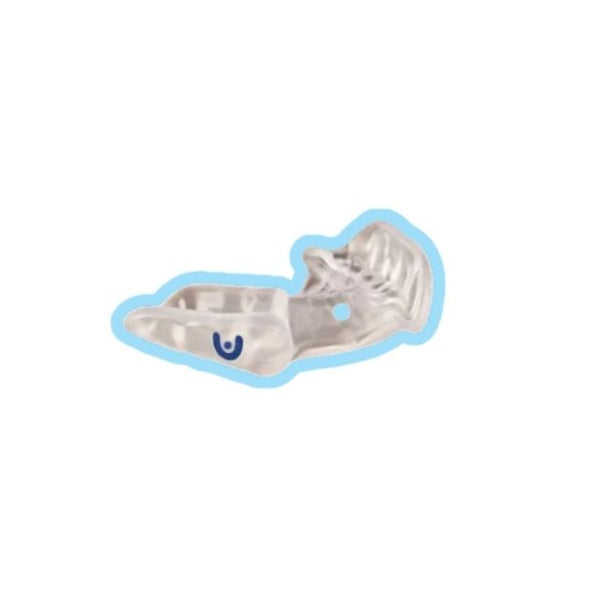
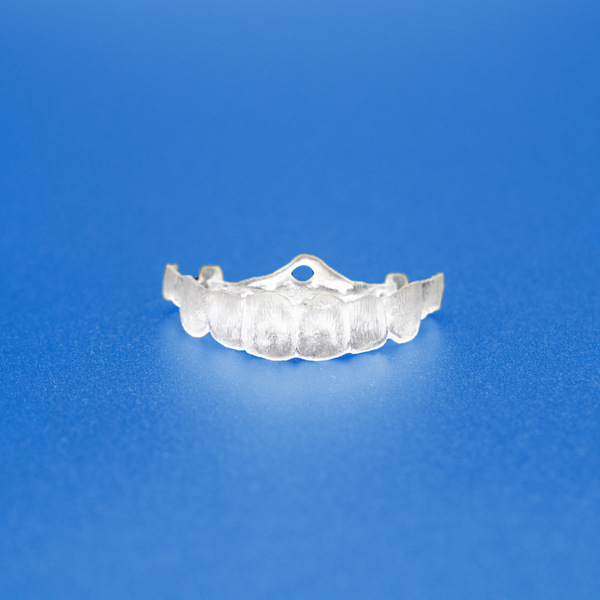
The tongue that seals the palate awake is the same tongue that seals the airway asleep. Rest-posture training during focused work — 30-60 minute stretches with an appliance like Adult Spot Pal — carries into nighttime because it becomes the neuromuscular default. This is the layer most sleep interventions skip. Tongue posture: the complete guide →
Layer 2 — Nighttime protection.
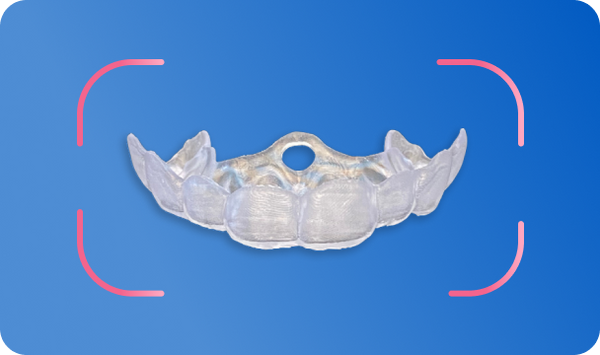
Night Pal — custom-fit soft nightguard, 2mm. Protects the enamel from active bruxism while the daytime rest-posture retraining is still emerging. Non-optional if snoring or grinding is present. Full night-training breakdown →
Layer 3 — Environmental setup.
Standard sleep-hygiene fundamentals — dark, cool, consistent — do their real work once the airway is fixed. Screen curfew, temperature at 66-68°F, no alcohol 3 hours before bed, dim light after sunset. These are the compounding layers, not the load-bearing ones. Sleep-friendly environment →
Layer 4 — When to escalate to medical evaluation.
If snoring is severe, if a partner has witnessed apneas (pauses in breathing), if morning symptoms include gasping, or if daytime sleepiness is safety-relevant (falling asleep at the wheel, in meetings), a formal sleep study is warranted. The myofunctional protocol is complementary to medical evaluation for sleep-disordered breathing — not a replacement for it. Sleep apnea treatment options →
Full stack: The Gym & Bedroom System pairs Night Pal with Adult Spot Pal — the two layers most airway-compromised sleepers are missing from a hygiene-only protocol.
Shop Gym & Bedroom · $250When Sleep Problems Aren't Airway-Driven
The mechanism doesn't fit every case. If any of these apply, treat those first — myofunctional protocol is complementary, not primary:
- Documented moderate-to-severe sleep apnea on a sleep study — CPAP or oral appliance therapy is the primary intervention. Myofunctional work is adjunct.
- Circadian rhythm disorders — shift work, delayed sleep phase, jet lag — need chronotherapeutic approaches.
- Insomnia without airway markers — often responds to CBT-I (cognitive behavioral therapy for insomnia) primarily.
- Depression, anxiety, chronic pain disrupting sleep architecture — treat the primary condition.
- Medications — many prescriptions affect sleep architecture. Review with prescriber before assuming airway.
For the majority of "I sleep fine but wake up tired" cases that don't hit those flags, the four-layer protocol addresses the mechanism at the level it's actually broken.
"I was waking up at 3 AM every single night for three years. Convinced it was stress, tried melatonin, tried magnesium, tried therapy. My dentist finally mentioned my worn cusps and asked how I slept — she put me in Night Pal and told me to start wearing Adult Spot Pal during work. Two months in the 3 AM wakeups just stopped. Never once thought it was my tongue."
The Layered Night Stack
Common Questions
Is snoring always an airway problem?
Snoring is always the sound of turbulent airflow past a partially collapsed structure — so mechanistically, yes, it's always airway. What varies is severity and cause. Occasional light snoring may reflect a mild positional issue; nightly loud snoring, especially with witnessed apneas or gasping, warrants a formal sleep study. Tongue-posture protocol addresses the mechanism at the mild-to-moderate end.
Can Spot Pal replace a sleep study or CPAP?
No. Documented moderate-to-severe sleep apnea requires medical evaluation and, in most cases, CPAP or an oral appliance prescribed by a sleep physician. Spot Pal is a myofunctional posture-training appliance — it addresses the upstream tongue-and-airway posture that contributes to airway compromise, but it does not diagnose or treat apnea. Work it in as an adjunct with your sleep physician.
How does daytime tongue training carry into sleep?
Rest posture is a neuromuscular default — where your tongue lives when you're not thinking about it. Training it awake with a tactile anchor rewires that default over weeks. Once the default is "tongue sealed against palate," it holds during sleep too, because sleep is when your defaults run. The daytime work is the training window; nighttime is where the training pays.
How long before sleep quality improves?
Most users report morning-symptom changes (jaw fatigue, dry mouth, partner-reported snoring) in weeks 4-8. Deeper markers — night wakings, morning heart rate, cognitive freshness — typically shift at 8-16 weeks. Full pattern consolidation usually settles in 3-6 months. Individual variation is significant.
My kid snores and sleeps mouth-open — is this normal?
It's common but not benign. Pediatric airway compromise correlates with attention issues, dental crowding, palatal shape changes, and delayed development. Any child snoring nightly, sleeping mouth-open, or showing restless legs/bedwetting past age 5 warrants pediatric airway evaluation. In this window the palate is still plastic — early intervention is disproportionately valuable.
Do I wear Adult Spot Pal at night?
No. Adult Spot Pal is a daytime resting-posture appliance worn in 30-60 minute stretches during focused work — reading, screen time, deep-work. Night Pal is the nighttime device, designed for the sleep-clench pattern. They work together as complementary layers, not interchangeably.
Share:
TMJ Disorders: The Complete Guide
Kids & Tongue Posture: The Parents' Guide