

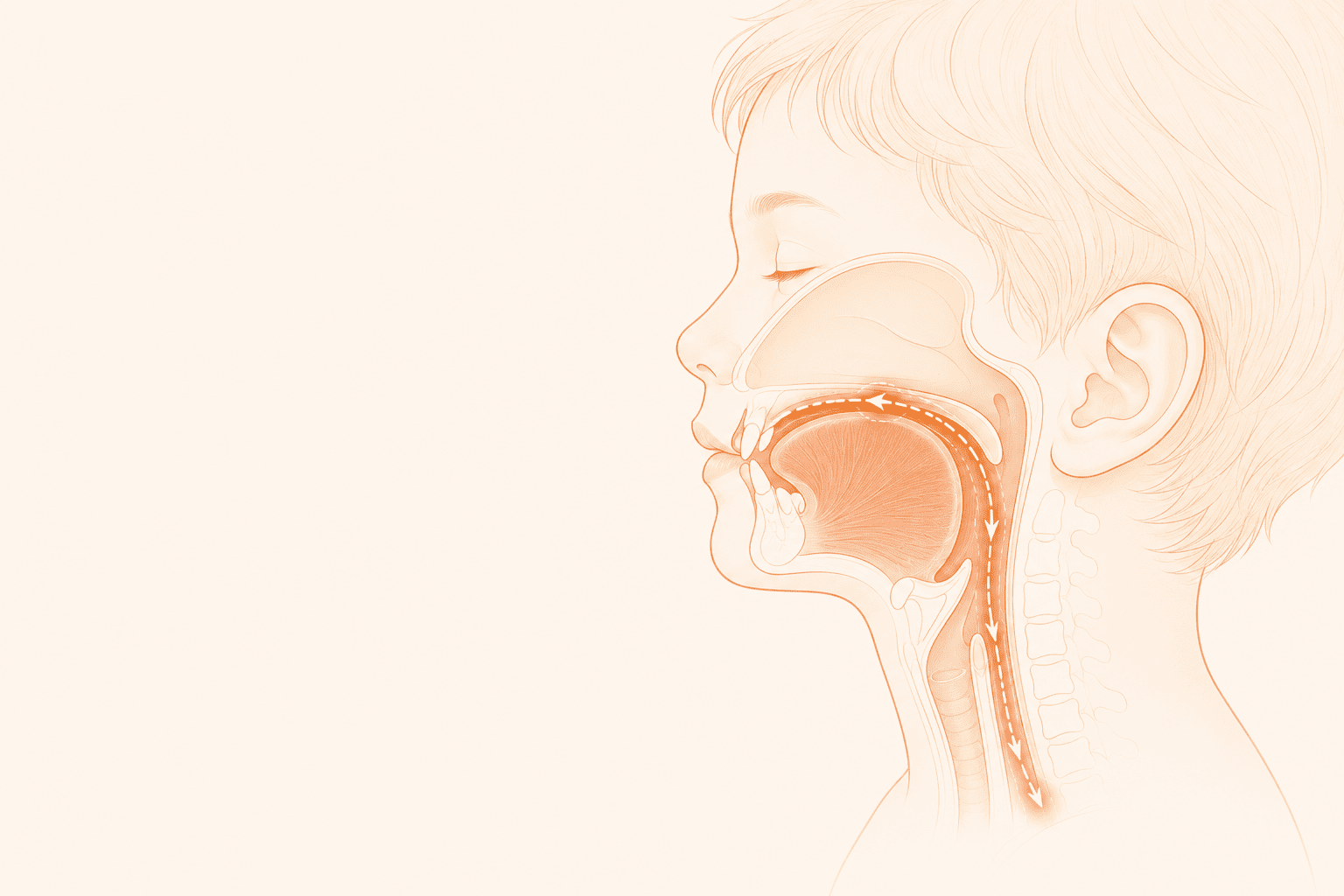
Speech delay. Mouth-open sleep. Crowded teeth. Restless nights. Focus problems. Parents get told these are five separate issues seen by five separate specialists. They're often one issue — where the tongue lives.
Between roughly ages 3 and 12, palatal shape, dental arch, airway function, articulation, and sleep architecture are all developing under one shared variable: resting tongue posture. Fix that upstream and four downstream problems tend to move at the same time.

Why Five Kid Issues Are Often One Kid Issue
In modern pediatric care, a child with speech delay sees a speech-language pathologist. A child with crooked teeth sees an orthodontist. A child with restless sleep sees a pediatrician. A child with focus issues gets a behavioral referral. Four different specialists, four different treatment paths — and often, one shared upstream mechanism.
The mechanism is where the tongue lives when nobody's looking. Between roughly ages 3 and 12, the tongue is shaping four structures simultaneously:
- The palate. A tongue resting against the palate widens and flattens the dental arch. A tongue resting on the floor of the mouth narrows and vaults it. High narrow palates are strongly correlated with dental crowding.
- The articulatory space. A high narrow palate constrains the room the tongue has to make /r/, /l/, /s/, /th/. Articulation errors that traditional therapy struggles to generalize often live here.
- The airway. A tongue that drops back at night narrows the pharyngeal airway. That produces mouth-breathing sleep, snoring, restless nights, and fragmented sleep architecture.
- The face itself. Long-term mouth-breathing pattern in a developing face is associated with a longer facial growth, retruded chin, dark under-eye circles, and open-mouth resting posture — the classic "adenoid face."
Correcting rest posture in the developmental window is disproportionately valuable because the palate is still plastic. Wait until age 14 and you're working against a set structure; act at age 6 and you're shaping it. The kids' lander →
Six Signs Your Child's Tongue Is Living In The Wrong Place
If two or more of these are present, myofunctional assessment should be on the list of referrals. Individually any one can be developmental noise; together they're a pattern.
Open-mouth resting posture.
Lips habitually apart at rest, tongue visible in the floor of the mouth. Often paired with forward head posture.
Snoring or mouth-open sleep.
Nightly snoring in a young child is not benign. Paired with restless legs, bedwetting past age 5, or morning irritability, it warrants pediatric airway evaluation.
Speech that isn't clarifying.
Persistent /s/, /r/, /l/ errors past developmental age norms. Especially interdental /s/ with visible tongue protrusion.
Effortful or messy eating.
Prolonged mealtimes, food packing in cheeks, spillage. Signals a swallow pattern that isn't organizing tongue-palate contact.
Focus issues at school.
Fragmented sleep from airway compromise looks like ADHD in a classroom — inattention, restlessness, poor working memory. Rule out sleep before assuming behavioral.
Orthodontic crowding.
Dentist flags a high narrow palate or crowded arch. This is structural evidence of long-term low-tongue habit.
The Developmental Windows That Actually Matter
Palatal plasticity, articulation acquisition, and airway development don't happen on the same timeline. Understanding which window your child is in determines what's realistically achievable.
Ages 3-5 — the prevention window
Palatal shape is highly plastic. Speech-sound acquisition is still in progress. Sleep-airway pattern is establishing. Intervention here — even simple lip-closure and nasal-breathing practice with a pediatric myofunctional therapist — is disproportionately valuable because you're shaping structure that's still forming. Healthy habits for kids →
Ages 5-12 — the peak intervention window
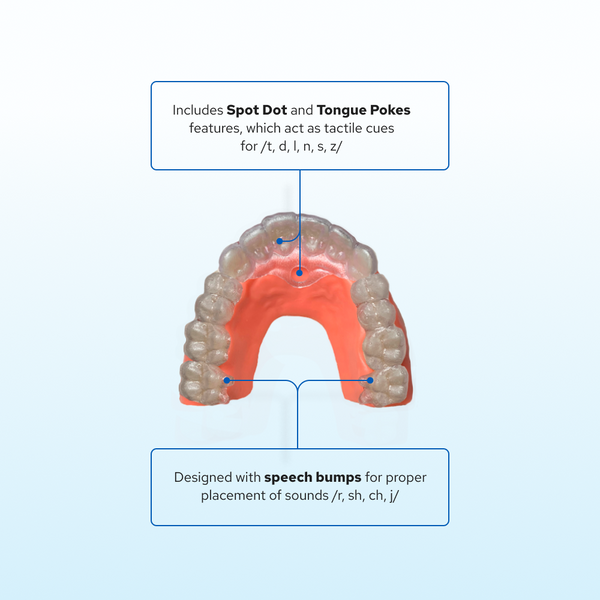
This is where most tongue posture appliances are indicated. Palatal shape still developing. Peak articulation-therapy window (school-age SLP referrals cluster here). Peak orthodontic evaluation window. Spot Pal Junior (ages 5-12) and Spot Pal Mini serve this window directly — both trainable devices that give the tongue a tactile "spot" to home against during rest hours. Speech development: the complete guide →
Ages 13-17 — the pre-adult correction window
Palate is less plastic. Neuromuscular habits still trainable. Often paired with orthodontic work — the myofunctional adjunct significantly reduces post-brace relapse. Adolescent compliance is the variable; motivation-based framing tends to work better than parent-mandated. Tongue thrust: the guide →
A Parents' Protocol — How To Actually Do This
Kids don't respond to "hold your tongue against the roof of your mouth." They respond to a tactile anchor, a structured practice window, and consistency without pressure. Here's the layered protocol.
Step 1 — Get an assessment.
Pediatric myofunctional therapist or SLP who screens for myofunctional posture. Not every SLP does — ask specifically. If they don't, the pediatric dentist can often refer to one who does.
Step 2 — Pick the right device for the case.
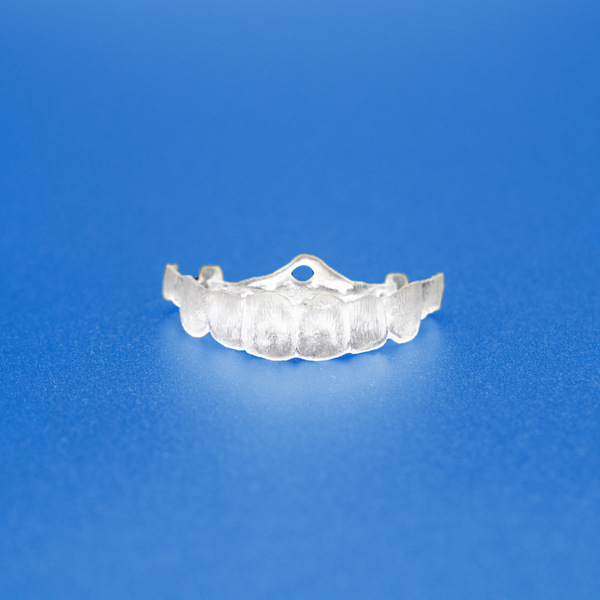
Spot Pal Junior is the full training appliance for ages 5-12 — indicated when there's a clear myofunctional picture (speech + swallow + airway together). Spot Pal Mini is the entry-level version — often the right first step for milder cases or family cost sensitivity. Both give the tongue a tactile "spot" to find at rest.
Step 3 — Build a practice window.
Homework hours, reading time, and quiet play are ideal. 30-60 minutes at a stretch. Screen time works but is second-choice — you want the child engaged in something that quiets talking so the tongue can rest against the palate. Practical exercises →
Step 4 — Address the airway at night.
If sleep-airway markers are present (snoring, mouth-open sleep, restless legs), pediatric airway evaluation is warranted. Standard first-line treatment for pediatric airway compromise may include ENT evaluation for adenoids/tonsils; myofunctional work is complementary, not primary. Mouth breathing and sleep quality →
The trainer. Spot Pal Junior is patented, SLP-developed, designed for kids age 5-12. Ships with a video training program.
Shop Spot Pal Junior · $229"My son was seven, mouth-open sleep, mouthing his /s/, and starting to have focus issues at school. Four different specialists said four different things. His pediatric dentist finally asked about his tongue — sent us to a myofunctional therapist. Two months of Spot Pal Junior during homework and his teacher asked if we'd changed his ADHD meds. He wasn't on any."
Which Spot Pal For Which Kid
Common Questions
What age should we start?
Spot Pal Junior and Mini both fit ages 5-12. If your child is under 5 with clinical markers, work with a pediatric myofunctional therapist first — the age-appropriate protocol at that stage is exercise-based rather than appliance-based. If your child is 13+, the adolescent window still allows meaningful correction — Junior may still fit; some teens transition to Adult Spot Pal.
Junior or Mini — how do we decide?
Junior is the full training appliance — indicated when there's a clear myofunctional picture (speech + swallow + airway together, or a therapist recommends full training). Mini is the entry-level version — often the right first step for milder cases, early exploration, or family cost sensitivity. A pediatric SLP or myofunctional therapist can help match device to case.
Do we need a therapist or can we do this ourselves?
A pediatric myofunctional therapist or SLP screen is strongly recommended before starting. They confirm the mechanism fits your child's case, rule out other causes, and structure the practice pattern. Spot Pal ships with a video program that supports the training, but it's designed to complement clinical work — not replace assessment.
Is this the same as an orthodontic appliance?
No. Orthodontic appliances move teeth. Spot Pal trains resting tongue posture. The two often pair well — orthodontists increasingly recommend myofunctional adjunct work to reduce post-treatment relapse — but they're addressing different structures.
My child snores — should we do a sleep study first?
Yes. Pediatric snoring is not benign. Nightly snoring, especially with witnessed apneas, restless legs, or bedwetting past age 5, warrants pediatric airway evaluation. ENT may recommend adenoid/tonsil assessment. Myofunctional work is an adjunct to that pathway, not a replacement for it.
How long before we see a change?
Most parents notice mouth-closed rest posture emerging within the first 2-4 weeks of consistent daily use. Sleep pattern changes (partner-reported quiet breathing at night) typically emerge at 6-10 weeks. Speech generalization and orthodontic markers move over months. Consistency matters more than intensity.
Share:
Sleep & Airway: The Complete Guide
Nasal Breathing for BJJ & Combat Athletes