

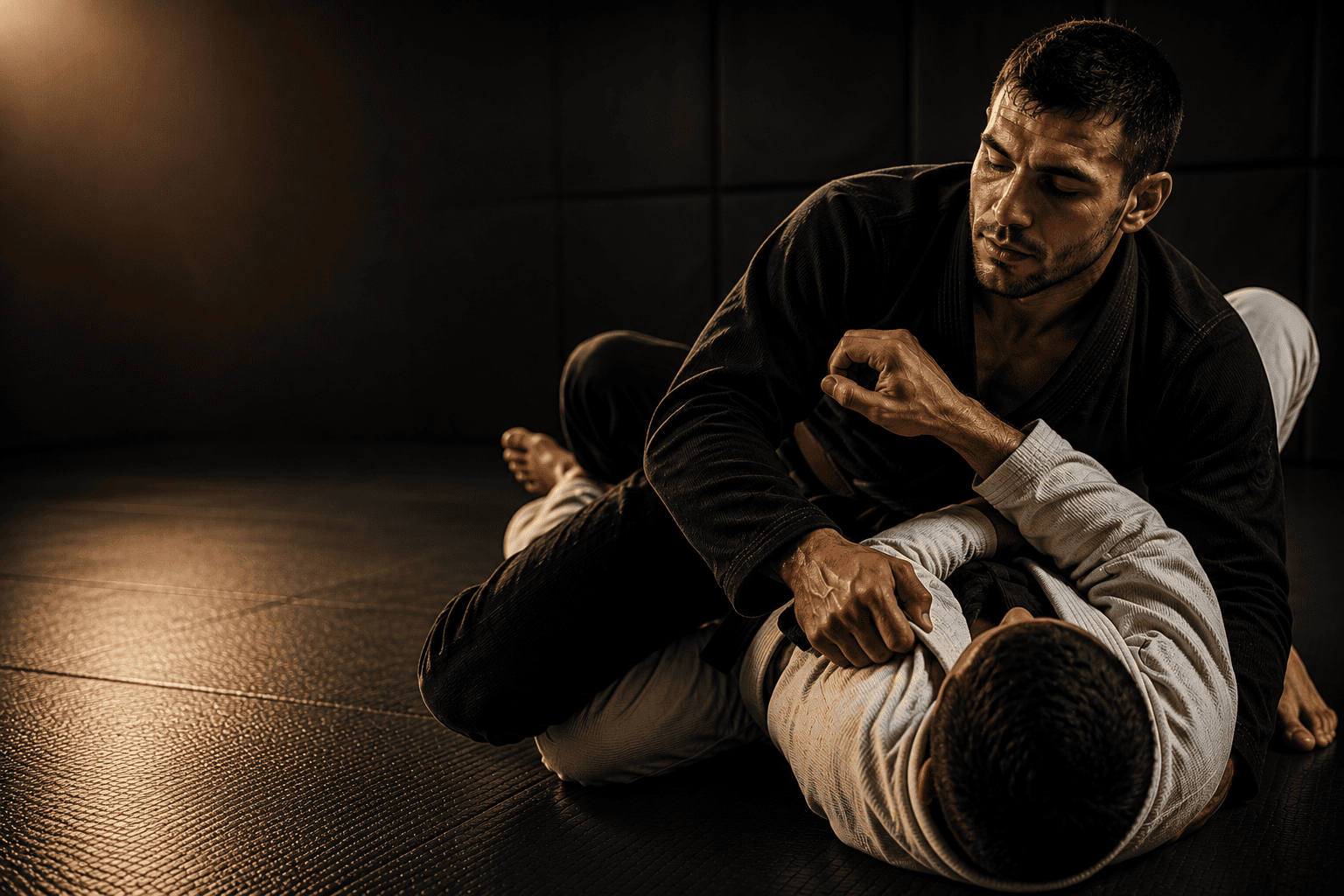
The reason you fade in the third round isn't cardio. It's the moment nasal collapses to mouth. That transition is where fights are won and lost — and it's trainable.
Elite combat coaches have been quietly working nasal breathing for years. Here's the mechanism, why it matters more for grappling and striking than any other sport, and a 4-6 week progression that pushes your gas-out threshold higher.

Why Combat Sport Punishes Mouth Breathers Faster Than Anything Else
Every sport rewards conditioning. Combat sport punishes the lack of it in a specific way — you don't just fatigue, you make bad decisions. A grappler who mouth-breathes under a top pin is exchanging every second of air debt for cognitive bandwidth. Late-round striking is the same equation played out standing up.
Three specific things happen when you collapse to mouth breathing in the middle of a round:
- CO2 dumps too fast. Mouth breathing pushes carbon dioxide out faster than nasal. Lower CO2 shifts the Bohr effect — the mechanism that unloads oxygen from your blood to your working muscle. Ironically, breathing more air means less oxygen actually delivered where you need it.
- Sympathetic tone spikes. Mouth breathing under stress ramps the fight-or-flight response higher than nasal breathing does. That's fine for a five-second explosion. Not fine when you have two more rounds and need decision-making bandwidth.
- The tongue drops back. When the tongue-palate seal breaks, the base of the tongue pulls into the airway. It literally narrows your own airflow at the moment you need the most.
The training goal is not to be nasal-only forever — nobody expects you to breathe through your nose during a scramble at max intensity. The goal is to push the transition point from nasal to mouth as high as possible. The higher that ceiling, the later you fade. Full athletic performance pillar →
Four Signs You're Leaking Air The Wrong Way
You start mouth-breathing before round two.
If your nasal window is only warm-ups plus round one, your CO2 tolerance is capped low. This is trainable.
Your jaw locks during hard rolls.
Clenching under load is a compensation for a tongue that isn't sealing the palate. It costs you neurologically without producing output.
You gasp in the corner between rounds.
Deep mouth-breath recovery is fine when you've earned it. If you're gasping just to reset, your baseline breath pattern is running you inefficient.
You dread the third round mentally, not physically.
Sympathetic overload from mouth breathing shows up as decision-making fog before it shows up as physical fatigue. The cognitive fade is often earlier than the cardio fade.
The 4-6 Week Progression That Actually Works
You don't add a new training block. You retrofit your existing work — mobility, warm-ups, tempo, sparring. Progression is what separates athletes who see change from athletes who quit.
Weeks 1-2 — baseline nasal-only
Two to five minutes daily, at rest. Mouth closed, tongue against the palate, breath slow through the nose. If your nose feels congested, that's expected — nasal tissue adapts to consistent use over two to four weeks. Also start wearing Boil & Bite Sport Pal during mobility and warm-ups to reinforce the tongue-palate seal.
Weeks 2-4 — warm-up nasal window
Warm up entirely nasal-only. Zone 1-2 output. If your breath collapses to mouth, back the intensity down until it holds. This is how CO2 tolerance expands. Sport Pal continues through warm-up and light drilling.
Weeks 3-5 — nasal-only positional drilling
Once nasal holds at warm-up, layer it into flow rolling, low-intensity drilling, easy bag rounds. Any sub-hard-spar output. This is where your gas-out threshold measurably shifts upward. Five breathing exercises →
Weeks 4-6 — competition-intensity carryover
At this point you have a higher ceiling. Hard sparring will still transition you to mouth — that's fine. What's different is when. You'll notice the round-two collapse becomes a round-three collapse. That's the training win. The athlete lander →
"I've been rolling for eight years. Assumed I was just a gasser — genetic bad cardio, whatever. Started warming up nasal-only with Boil & Bite Sport Pal in for the drilling. Six weeks later I'm still nasal into flow rolls and my coach flagged that I'm making better decisions late. Same conditioning work I always did. Just breathing right for once."
Common Questions
Is Boil & Bite Sport Pal a competition mouthguard?
No. Sport Pal is a training tool for tongue posture, not an ASTM-rated impact mouthguard. If your competition requires impact certification (boxing, MMA competition), wear your competition guard for hard sparring and comps. Wear Sport Pal for warm-ups, flow rolling, drilling, mobility, and roadwork.
How is this different from taping my mouth shut?
Mouth breathing forcing tools shut the airway externally. Sport Pal trains the internal mechanism — where the tongue lives — so nasal breathing becomes autonomous. External restriction can teach the pattern short-term but does not retrain the tongue-palate seal that runs the pattern long-term. Different tools for different mechanisms.
When do I switch to mouth breathing?
At true maximum effort — everyone mouth-breathes eventually, and that's built in. The training goal isn't to be nasal-only forever. It's to push the ceiling of nasal-under-load higher so the transition point in a fight is later, not earlier.
Do I keep wearing it after 4-6 weeks?
Most athletes keep it in warm-ups and mobility indefinitely — the tactile "spot" for the tongue is a useful anchor even after the pattern has generalized. Some use it during roadwork and steady-state cardio. For hard sparring and competition, use your competition guard.
Will this help me cut weight?
Indirect. Better sleep from tongue-posture correction can support recovery and body-composition work over months. But this is a conditioning-mechanism tool, not a weight-cut tool. If cut protocol is your goal, that's a nutrition and sauna conversation.
Share:
Kids & Tongue Posture: The Parents' Guide
Morning Headaches: The TMJ / Airway Overlap