

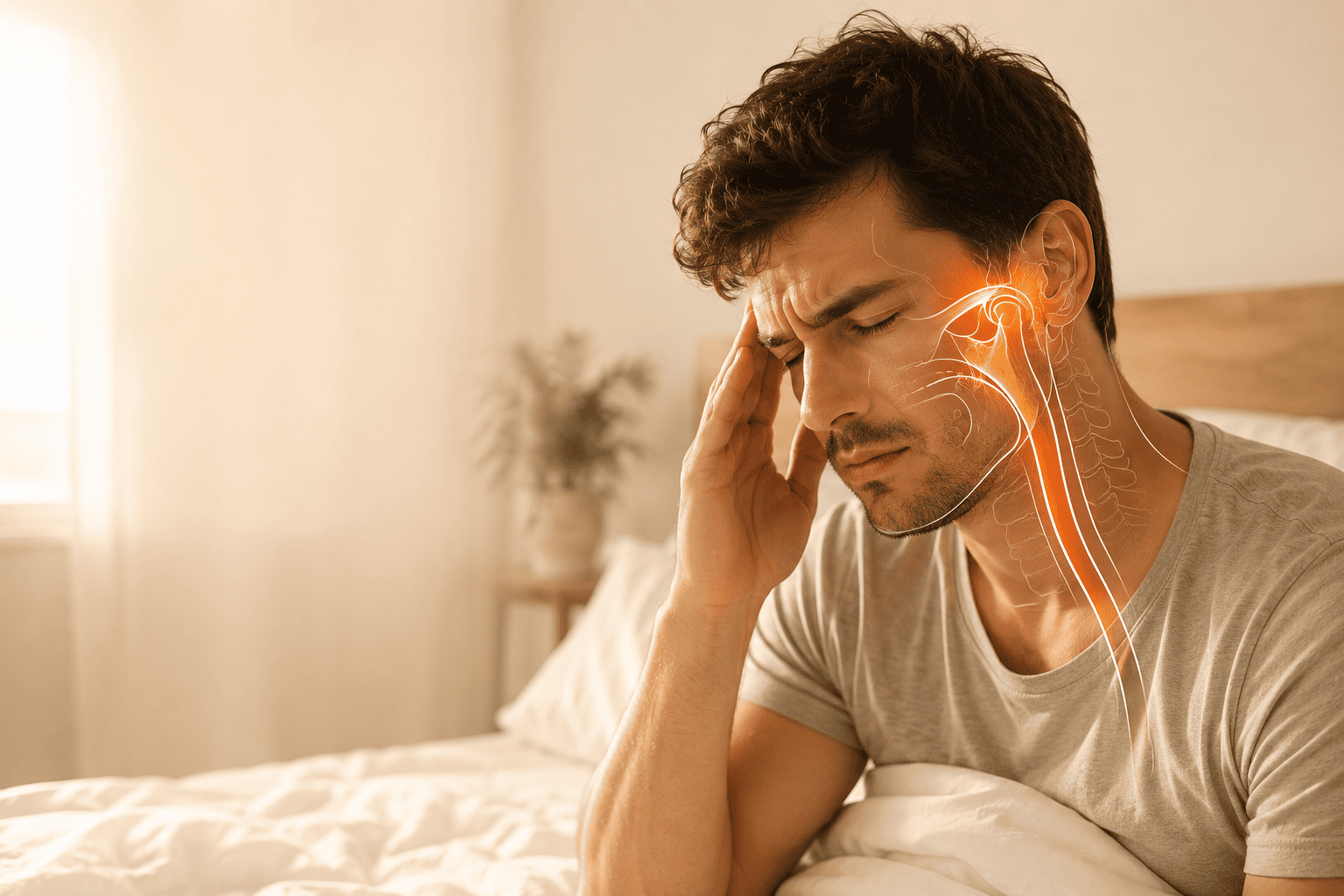
Waking up with a headache is not a stress problem or a hydration problem. It's a signal — the same one your dentist calls TMJ and your primary care calls poor sleep. They're the same pattern seen from two clinical doors.
Here's the mechanism that ties them together, why treating one without the other leaves the pattern intact, and the four-layer protocol that actually resolves morning headaches at the cause.

Why Your Dentist And Your Doctor Are Describing The Same Thing
A patient walks into a dental office describing morning headaches. The dentist finds worn cusps and prescribes a nightguard for TMJ. The same patient describes it to their primary care doctor, who orders sleep questionnaires and prescribes better sleep hygiene. Neither is wrong. Neither, on its own, is enough — because they're describing the same underlying pattern from two different clinical vantage points.
The pattern is this: at night, when the tongue and jaw don't hold posture correctly, the airway narrows. The nervous system responds — by clenching the jaw forward to protect airway patency. That protective clench is what your dentist sees as TMJ. The mildly disrupted sleep architecture from the same night pattern is what your doctor sees as poor sleep. The morning headache is the downstream signal of both.
- The airway compromise is upstream. It's what starts the cascade.
- The protective bruxism is the compensation. It's what the jaw does to keep the airway open.
- The morning headache is the aftermath — masseter tension, temporalis fatigue, disrupted sleep.
Treat only the teeth (nightguard) and the pattern keeps firing. Treat only the sleep environment (better hygiene) and the airway still collapses. Address the mechanism at the airway and the whole cascade quiets. Full TMJ mechanism breakdown →
Five Signs Your Morning Headaches Are In This Pattern
Not every morning headache fits the airway-TMJ pattern. If two or more of these are present, this is likely the mechanism.
You wake with tight temples or sore jaw.
The temporalis and masseter are the muscles doing the night clench. Morning fatigue in those muscles is the clearest local signal.
Dry mouth or a partner reports snoring.
Both are markers of mouth-open sleep. Every night in this pattern reinforces it.
Headache fades over 1-2 hours after waking.
Airway-related morning headaches often clear as CO2 and posture normalize during the morning. Migraines and tension-type headaches tend to run differently.
Your dentist has flagged worn cusps or scalloped tongue.
Both are structural evidence of nighttime pressure patterns — worn cusps from grinding, scalloped tongue edges from pressing against the teeth.
You've had a nightguard for 6+ months and still have headaches.
Nightguards protect the teeth. They don't address the upstream airway compromise driving the bruxism. Chronic pain despite the appliance is a signal to look upstream.
The Four-Layer Fix That Actually Works
Treating morning headaches at the cause means addressing each layer of the pattern — not just the pain.
Layer 1 — Protect the teeth (Night Pal).
A custom-fit nightguard buffers the enamel from active bruxism while the upstream work is emerging. Non-optional if grinding is present. This is the layer most patients already have. Understanding & treating teeth grinding →
Layer 2 — Retrain daytime rest posture (Adult Spot Pal).
The tongue-palate seal that keeps the airway open at night is a daytime-trainable neuromuscular habit. 30-60 minute stretches with a resting-posture appliance during focused work — reading, screens, deep-work — builds the habit that carries into sleep. This is the layer most conventional TMJ workups skip. Tongue posture pillar →
Layer 3 — Address the airway.
Nasal-breathing habits, allergies, deviated septum, sleep position — any factor narrowing the airway compounds the pattern. Basic hygiene changes (nasal irrigation, side-sleeping, elevated head-of-bed) plus specialist referral if snoring is severe. Mouth breathing complete guide →
Layer 4 — When to escalate.
If snoring is severe, if a partner witnesses apneas, or if daytime sleepiness is safety-relevant, a sleep study is warranted. This four-layer protocol is complementary to medical evaluation for sleep-disordered breathing — not a replacement. Daily habits that worsen TMJ →
"Two years of morning headaches, a nightguard, three migraine medications, a sleep hygiene overhaul. Nothing moved. My dentist finally asked how I breathed — turns out I'd been mouth-open sleeping since I was a teenager. Added Adult Spot Pal during work. Six weeks and the morning headaches stopped. I'd been treating five different things that were all one thing."
Common Questions
How do I tell if my morning headache is TMJ/airway vs migraine?
TMJ/airway morning headaches tend to feature bilateral tight-temple or masseter fatigue, typically clear within 1-2 hours of waking, and improve with jaw stretching, hydration, and nasal breathing. Migraines are usually unilateral, throbbing, often with light or sound sensitivity, and don't resolve on their own within an hour or two. A headache specialist can help differentiate — bring both patterns to the visit.
If I already have a nightguard, do I still need this?
Keep the nightguard — it's protecting your teeth. What Adult Spot Pal adds is the upstream daytime work that trains rest posture, which is what makes the nighttime pattern quiet down. The two work together: nightguard for enamel, Adult Spot Pal for mechanism.
How long before morning headaches improve?
Most patients report awareness of jaw rest position within 2-3 weeks. Morning-symptom reduction typically emerges at 6-10 weeks. Full resolution — or stable long-term reduction — usually settles at 3-6 months. Individual variation is significant depending on the airway component.
Should I get a sleep study?
If any of these apply, yes: severe snoring, witnessed pauses in breathing, gasping/choking waking, daytime sleepiness safety-relevant (falling asleep at wheel or in meetings), or morning headaches that don't respond to the protocol above over 3 months. The myofunctional layer is complementary to medical sleep evaluation — not a substitute.
Can stress cause this pattern by itself?
Stress amplifies existing bruxism, but pure "stress-only" bruxism is less common than assumed. In most chronic cases the airway component is present but under-diagnosed. Even in confirmed stress-driven cases, the four-layer protocol reduces damage and duration.
Share:
Nasal Breathing for BJJ & Combat Athletes
Sleep Apnea Treatment: What Works Beyond CPAP