

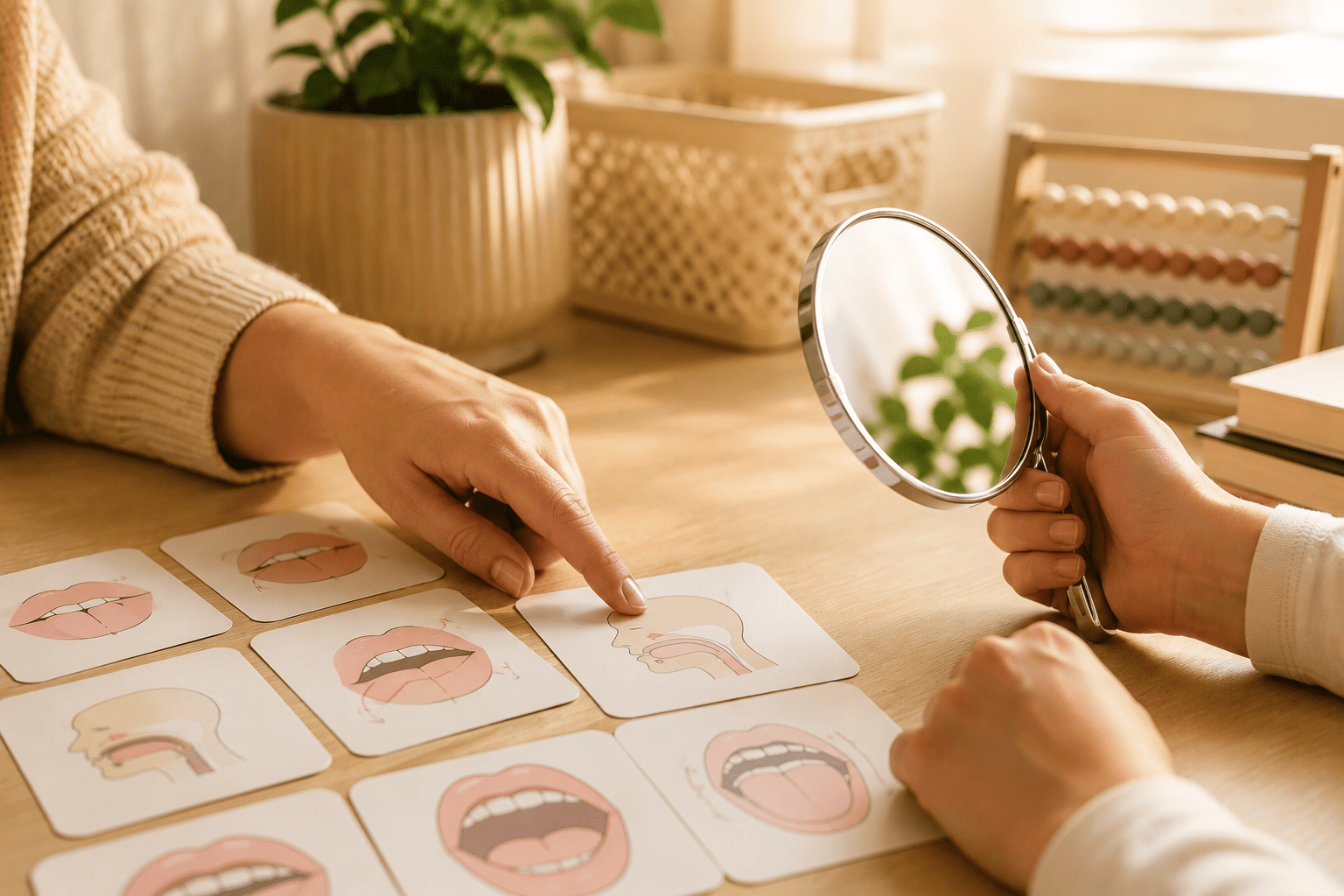
Articulation, tongue thrust, and the swallow pattern all trace back to one variable most speech evaluations don't formally test — where the tongue lives at rest.
Speech-language pathologists and myofunctional therapists have been working this together for two decades. Here's what they actually train, why it matters, and how a patented resting-posture appliance fits into the protocol.

What Most Speech Evaluations Don't Formally Test
A standard speech assessment maps articulation errors, screens language, and looks at fluency. What it typically doesn't isolate is orofacial myofunctional posture — the resting position of the tongue, lips, and jaw between sounds. That resting position is where articulation errors are made, and it's where they're corrected.
Here's what the myofunctional-therapy literature has documented that a standard SLP battery often misses:
- A resting low-forward tongue is the substrate of most /s/, /z/, and /th/ errors. If the tongue sits against the lower teeth at rest, it can't organize a clean tip-alveolar contact for those sounds. Articulation drills that don't first correct rest posture are drilling against a substrate that keeps regressing.
- Tongue thrust — the interdental swallow — appears in 60-80% of children with articulation disorders (Wadsworth et al., published estimates vary by criteria). The thrust pattern reinforces low-forward posture with every one of the ~1,000+ swallows per day, drilling the very habit therapy is trying to unwind.
- Palatal shape and dental arch develop under tongue pressure. Tongue against the palate widens the arch; tongue in the floor narrows it. High narrow palates (common in mouth-breathing kids) constrain the space the tongue has to maneuver for /r/, /l/, and lingual-alveolar articulations.
- Adult speech-clarity issues often trace to unresolved childhood tongue posture. The lisp that "just never went away" is usually a posture problem that outlasted its articulation therapy because the substrate was never re-trained.
This is why myofunctional therapy has become a common SLP adjunct — and why the standard therapy protocol for stubborn articulation errors now often starts with rest-posture work, before traditional articulation drills. Tongue thrust: what it is and how it's treated →
Signs Tongue Posture Is Compromising Speech
These clinical markers show up on evaluation. If a child (or adult) is presenting with two or more, myofunctional assessment should be on the differential.
Interdental /s/ /z/ /th/ substitution.
Tongue tip protrudes between the teeth during production. Frontal or lateral lisp presentation. Usually paired with an interdental swallow.
Persistent open-mouth rest posture.
Lips habitually apart at rest, tongue visible in the floor of the mouth. Often paired with mouth breathing and forward head posture.
Stubborn /r/ or /l/ that won't stick.
Weeks or months of articulation therapy with regression each session. Sound emerges in structured drills but doesn't generalize.
Slow, effortful, or messy eating.
Prolonged feeding, food packing in the cheeks, spillage. Signals a swallow pattern that isn't organizing tongue-palate contact.
High narrow palate on oral-mech exam.
Vaulted palatal shape, often with dental crowding. Signals long-term low-tongue habit and reduced maneuvering space for lingual articulations.
Adult who "always had a lisp."
Articulation therapy in childhood partially resolved the error, but it re-emerges under stress or fatigue. Rest posture was never re-trained.
The Five Clinical Systems Tongue Posture Runs
Every downstream system a speech evaluation looks at — articulation, swallow, phonation, resonance, dentition — has resting tongue posture as an upstream variable. Understanding the five clinical linkages is what turns a stubborn case into a solvable one.
1. Tongue-palate seal & alveolar articulation
A clean /s/, /z/, /t/, /d/, /n/, /l/ requires a stable tongue tip against the alveolar ridge — the bumpy area just behind the upper front teeth. If the tongue's home base is the floor of the mouth, that tip-alveolar contact has to be built from scratch on every production. Training the tongue to rest at the "spot" behind the teeth is what makes articulation drills stick. Practical exercises for articulation →
2. Swallow pattern & tongue thrust
A mature swallow lifts the tongue up and back against the palate. An interdental swallow pushes forward against the teeth. Every one of the 1,000+ daily swallows either reinforces posture or unwinds it. Correcting the swallow pattern is core myofunctional-therapy work — and it's why articulation therapy alone often doesn't hold. Full tongue-thrust guide →
3. Palatal development & dental arch shape
Between roughly ages 3 and 12, palatal shape is under active development. Tongue against the palate widens and flattens the arch; tongue in the floor narrows and vaults it. High narrow palates are strongly correlated with mouth-breathing sleep patterns, dental crowding, and articulation difficulty for /r/ and /l/. Rest-posture correction in this developmental window has structural downstream benefit — orthodontic and speech both. Mouth breathing: the complete guide →
4. Airway, phonation & voice quality
The tongue sits at the top of the airway. When it drops, the pharyngeal space collapses, resonance shifts, and vocal quality can develop a nasalized or muffled character. Kids who breathe mouth-open at night present in the daytime with characteristic voice-quality markers that resolve as posture is retrained. Tongue posture: the complete guide →
5. Adult carryover — the errors that "never went away"
Adults who present with residual lisps, /r/ distortions, or "mumbly" speech are typically carrying a childhood posture pattern that outlasted the articulation therapy. Rest-posture correction in adulthood is slower than in kids — the neuromuscular habit is deeper — but it is trainable, and it's usually where a plateaued adult case unsticks. Speech clarity in adults →
How Myofunctional Work Pairs With Traditional SLP Protocol
Myofunctional therapy is not a replacement for articulation therapy — it's the substrate work that lets articulation therapy generalize. Here's how it stacks with a standard SLP protocol.
Phase 1 — Assessment (Week 0-2).
Standard articulation and language evaluation plus myofunctional screen: resting posture observation, swallow-pattern check, lingual frenulum assessment, and palatal-arch inspection. This determines whether rest-posture work is indicated as an adjunct or as a prerequisite.
Phase 2 — Rest posture retraining (Week 2-8).
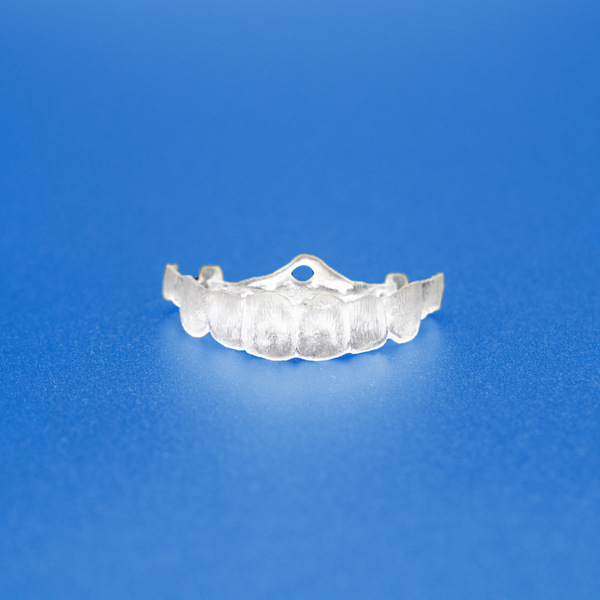
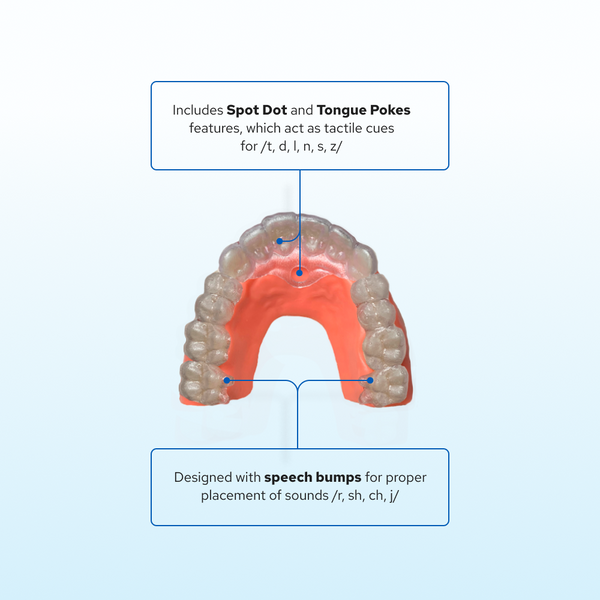
Establishing the tongue-palate seal at rest, several sessions per day, awake and passive. This is where a physical resting-posture appliance — one that provides a tactile "spot" for the tongue to home against — dramatically shortens the acquisition curve. Kids who couldn't feel where the tongue should be now have a landmark. This is what Spot Pal for Speech is designed for.
Phase 3 — Swallow retraining (Week 4-10, overlaps).
Traditional myofunctional swallow drills: liquid, food, then integrated. The rest posture built in Phase 2 makes the mature swallow accessible. Without Phase 2, Phase 3 slides.
Phase 4 — Articulation carryover (Week 6+).
Traditional SLP articulation therapy — but now against a corrected substrate. Sounds that were regressing between sessions begin generalizing to conversation. This is the payoff. Common misconceptions about speech disorders →
The right tool for Phase 2. Spot Pal for Speech is a patented resting-posture appliance developed by SLPs, designed specifically for the rest-posture retraining phase. Ships with a video program.
Shop Spot Pal for Speech · $229Age-Specific Applications
The mechanism is the same across ages, but developmental windows shift what's realistically achievable and how the training is structured.
Early intervention · Ages 3-5
Developmentally most responsive to posture work. Palatal shape still highly plastic. Where prevention is easiest — before school-age articulation errors calcify.
School-age · Ages 5-12
Peak SLP referral window. Spot Pal Junior (ages 5-12) or Spot Pal Mini (entry point) fits this population directly. Palate still developing — orthodontic and speech benefits compound.
Teens · Ages 13-17
Palate less plastic but rest-posture habits still trainable. Often paired with orthodontic work — myofunctional adjunct reduces post-brace relapse.
Adults
Palate structure is set, but neuromuscular habits are trainable. Adult Spot Pal for residual articulation errors, voice quality issues, or myofunctional post-orthodontic work.
"I'm an SLP and my own daughter had a stubborn /s/ that wasn't holding between sessions. I knew the mechanism — rest posture — but drilling posture without a tactile anchor is hard for a seven-year-old. She wore Spot Pal for Speech through homework each afternoon. Two months in, her /s/ generalized to conversation. I've since put it in front of six of my caseload families."
Which Spot Pal Fits
Common Questions
Is Spot Pal a replacement for speech therapy?
No. Spot Pal is a myofunctional appliance that trains resting tongue posture. It's designed to work alongside speech-language pathology or myofunctional therapy — not replace it. The device provides a tactile "spot" for the tongue to home against, which shortens the rest-posture acquisition curve that traditional articulation therapy depends on.
At what age should a child start?
Spot Pal Junior is designed for ages 5-12 — the peak developmental window for palatal plasticity and articulation therapy. Spot Pal Mini serves as an entry point for the same age band. Earlier intervention (ages 3-5) is possible but typically routed through a pediatric SLP or myofunctional therapist first for age-appropriate protocol.
How does tongue posture connect to tongue thrust?
Tongue thrust is the swallow pattern that pushes the tongue forward against the teeth. Low resting tongue posture is the substrate that makes the thrust pattern the path of least resistance. Correcting rest posture is Phase 2 of a myofunctional protocol; correcting the swallow is Phase 3. Both work together.
Do adults benefit from this or is it only for kids?
Adults benefit. Palatal shape doesn't change in adults, but neuromuscular habits are trainable at any age. Adult use cases include residual childhood articulation errors, voice quality issues rooted in low-tongue posture, and post-orthodontic myofunctional carryover. Timeline is slower than kids — the habit is deeper — but the mechanism works the same.
How is this different from a myofunctional exercise routine?
Myofunctional exercises are active drills; Spot Pal provides a passive resting-posture anchor between drills. The two are complementary, not competing. Most SLPs and myofunctional therapists who use Spot Pal use it during independent practice time (homework, reading, screen time) to keep the tongue in the correct position for extended periods — turning rest hours into training hours.
How long before we see progress?
Most families and clinicians report noticing the tongue-palate seal awareness within one to two weeks of daily use. Rest posture retraining that carries into conversation typically takes 6-12 weeks. Full articulation carryover — where the target sound generalizes to spontaneous speech — depends on the underlying case and the parallel SLP work, and typically emerges at 8-16 weeks.
Share:
Athletic Performance: The Complete Guide
TMJ Disorders: The Complete Guide