

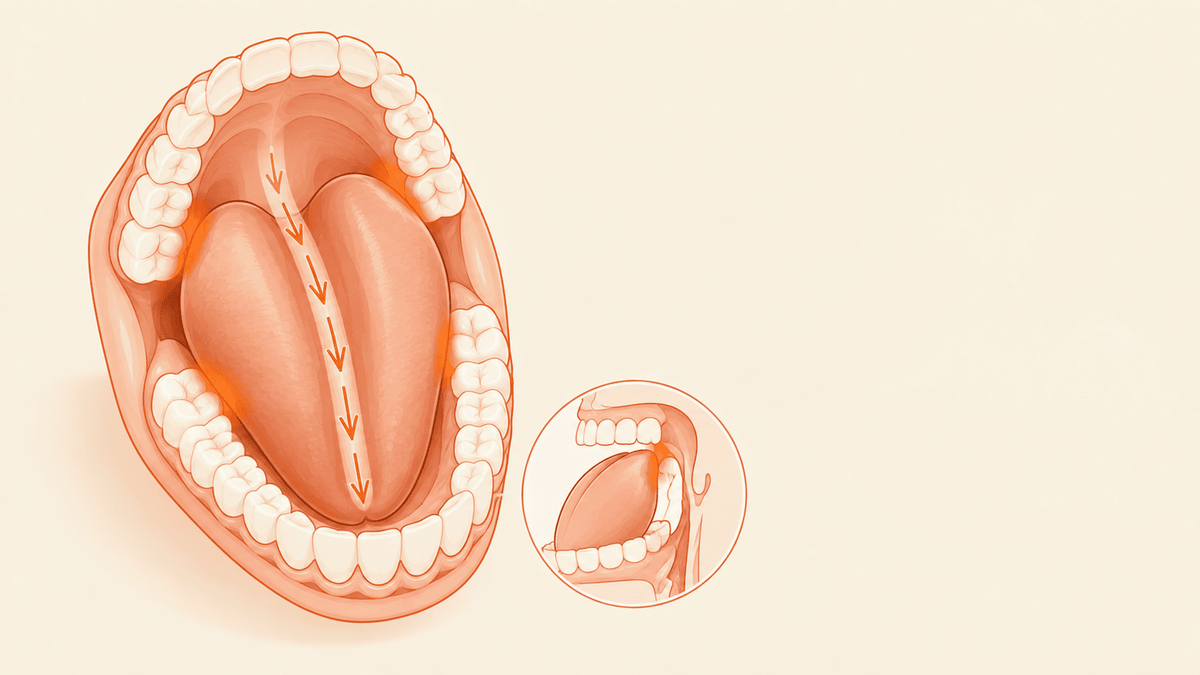
Lateral Lisp In Adults: Why It Hides From Traditional Articulation Therapy
Lateral lisp adults treatment fails when it targets the sound instead of the tongue posture producing it. Adults keep the lisp because the tongue's resting position, lateral bracing, and midline groove were never retrained... only the /s/ was drilled.
A lateral lisp in adulthood is not a "cute quirk" that survived childhood therapy. It is a stable neuromuscular pattern: the tongue rests low, spreads wide, and vents airflow over the sides of the molars instead of down a central groove. Articulation drills alone rarely dislodge it because the drill hour cannot outweigh the 23 other hours the tongue spends in the wrong posture. This piece explains the mechanism, why traditional therapy misses it, and the posture-first protocol clinicians are moving to.

The Mechanism: Why The Lisp Comes From The Tongue, Not The /s/
A clean /s/ requires three coordinated events. First, the tongue tip either lifts to the alveolar ridge or anchors just behind the lower incisors. Second, the lateral margins of the tongue seal against the upper molars to create a bracing wall. Third, a narrow midline groove channels airflow straight down the center of the mouth. When any one of those events collapses, air escapes over the sides of the tongue and produces the slushy, wet quality clinicians recognize as a lateral lisp.
In adults, the failure point is almost always lateral bracing. The tongue rests low in the floor of the mouth, the sides do not reach the molars, and the midline groove flattens because the tongue is spread rather than narrowed. Traditional articulation therapy asks the adult to produce a correct /s/ inside a therapy room. But the tongue defaults to its rest posture the moment attention releases. The pattern has been rehearsed thousands of times per day for decades. One 30-minute drill session cannot outvote it.
Our patented Spot Pal design targets that rest posture directly. By parking the tongue tip on the anterior spot and cueing the lateral margins to elevate, the appliance gives the tongue a physical reference point for where it belongs when the adult is not thinking about speech. That reference point is what articulation drills alone cannot install.
Rest Posture Is The Root
The tongue holds a posture for roughly 23 of every 24 hours. If that posture is low and spread, no drill hour can reprogram it. Retrain rest first, sound second.
Lateral Seal Is The Missing Skill
Adults with a lateral lisp cannot feel the sides of the tongue touching the molars. A tactile cue on the anterior spot triggers the lateral elevation as a reflex.
Muscle Memory Beats Willpower
Cognitive correction fails under fatigue, alcohol, or emotional stress. Posture that lives in muscle memory does not depend on attention to hold up.
Airflow Follows Structure
Once the midline groove is stable, the /s/ and /z/ correct themselves. The clinician stops chasing the sound and starts building the channel that produces it.
A lateral lisp in an adult is not a speech problem. It is a tongue posture problem that produces a speech symptom. Retrain the posture and the sound follows.
Why Traditional Articulation Therapy Misses It
| Traditional Articulation Approach | Posture-First Approach |
|---|---|
| Drills /s/ and /z/ in isolation, syllables, words | Installs anterior tongue-tip parking spot as reflex |
| Assumes structure is intact, only sound is wrong | Assumes rest posture is the driver, sound is downstream |
| Progress evaporates outside the therapy room | Progress compounds because posture is worn all day |
| Adult plateaus at 60 to 70 percent accuracy | Adult crosses 90 percent because posture holds under load |
| Fatigue, stress, alcohol collapse the correction | Muscle memory holds independent of cognitive attention |
The table is not an indictment of articulation therapy. It is precise about where articulation therapy runs out of runway. For a preschooler whose motor system is still plastic, drills work because the rest posture is still forming. For a 34-year-old whose tongue has held the same posture for three decades, the drill cannot compete with the posture. That is why so many adults report years of therapy without resolution, then note substantial change within weeks of a myofunctional retraining protocol anchored to a physical appliance.
How Spot Pal Fits

Speech Pal · $229
Purpose-built for speech clinicians and adult clients working on articulation. Installs the anterior spot as a reflex, giving the /s/ and /z/ a stable platform to rebuild on.
Shop Speech Pal
Adult Spot Pal · $229
The full-day adult platform for tongue posture, resting position, and airway support. Pairs with Speech Pal for adults whose lateral lisp co-occurs with mouth breathing or forward tongue posture.
Shop Adult Spot Pal"I had articulation therapy in second grade, fourth grade, and then again as a college freshman. Nobody ever talked about where my tongue lived when I was not talking. Six weeks with Speech Pal and my wife stopped hearing the wet /s/. That was after twenty-eight years of it."
Daniel R., Minneapolis
Frequently Asked Questions
Can a lateral lisp be corrected in adulthood?
Yes. Adult lateral lisps respond well to posture-first retraining because the mechanism is neuromuscular, not structural. The adult tongue is fully capable of learning a new resting posture and a stable midline groove. What changes is the method: articulation drills alone typically plateau, while posture-anchored protocols using an appliance like Spot Pal or Speech Pal address the root cause.
Why did childhood speech therapy not fix my lateral lisp?
Childhood therapy almost always targets the sound in isolation. That works when the tongue's rest posture is still being formed. If the low, spread posture stabilized before or during therapy, the drill hour could not outweigh the 23 non-drill hours. The lisp returns because the underlying posture was never retrained.
How long does adult lateral lisp retraining take?
Most adults notice audible change in the /s/ and /z/ within four to eight weeks of consistent posture work with an appliance. Full automatization... where the correct sound holds under fatigue, stress, and social pressure... usually takes three to six months. That timeline compresses when the adult wears the appliance daily rather than only during practice.
What is the difference between Speech Pal and Adult Spot Pal for a lisp?
Speech Pal is optimized for articulation clinicians and adults whose primary complaint is speech. Adult Spot Pal is the broader posture platform for adults whose lisp co-occurs with mouth breathing, forward tongue posture, or airway concerns. Many adults use both: Speech Pal during focused practice, Adult Spot Pal for full-day wear.
Do I need a speech-language pathologist to use Spot Pal for a lateral lisp?
Not required, but recommended. The appliance ships with a structured video program that walks the adult through posture, breath work, and articulation carryover. Adults working with an SLP or myofunctional therapist typically progress faster because the clinician can identify substitutions and coach the lateral seal directly.
Will fixing my rest posture actually change my /s/ sound?
Yes, and often faster than adults expect. Once the tongue's sides brace against the molars as a default, the midline groove forms without conscious effort. The /s/ then has a physical channel to travel through. Adults frequently report that the sound "just clicks" once the posture is stable, without additional articulation drilling.
Is a lateral lisp related to tongue tie or airway issues?
Often. A restricted lingual frenum can prevent the tongue from elevating to the palate, which forces a low, spread rest posture. Chronic mouth breathing produces the same low posture for a different reason. Either pathway can generate a lateral lisp downstream, which is why posture-first retraining is more durable than sound-only drilling.
Stop Drilling The Sound. Retrain The Posture.
Speech Pal and Adult Spot Pal ship with the structured video program that walks you through the posture-first protocol clinicians are moving to. Female-founded, patented, designed with SLPs.
Shop Speech Pal · $229Ships with the full training program. Clinician-designed. Patented Spot Pal mechanism.
Related reading: The Adult Program Overview · Tongue Posture Complete Guide · Mouth Breathing In Adults
Share:
Powerlifting Valsalva + Nasal Breath Sequencing: Bracing Without Losing The Airway
Post-Braces Speech Regression: When The Bite Changes And The Sounds Slip