

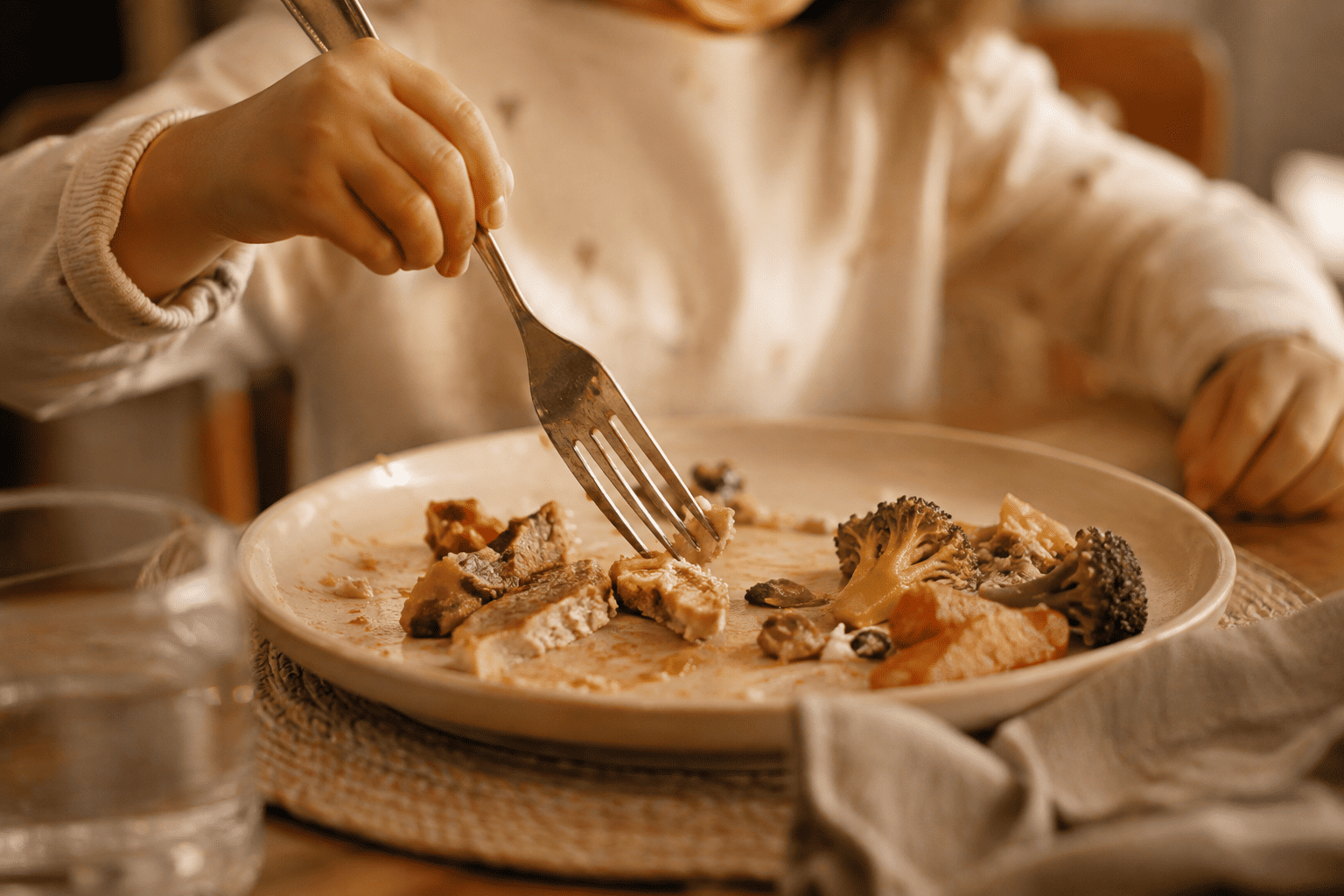
Mealtimes take 45 minutes. Your kid packs food in their cheeks. Chewy textures — steak, leafy greens — cause visible struggle. It's easy to write off as "picky eating." Often, it's tongue function.
Here's how tongue posture and mobility drive pediatric feeding difficulties, when to seek evaluation, and where myofunctional therapy fits.

The Tongue Runs The Meal
A functional mature swallow requires the tongue to: lift food to the palate, mash and rotate it for chewing, lateralize (move side to side) to work each dental arch, then organize the bolus and propel it back to swallow. All of that runs through tongue mobility and posture.
Kids with restricted tongue mobility (tongue tie), low resting posture (chronic mouth breathers), or immature swallow patterns (tongue thrust) can't do all those tongue tasks efficiently. Meals take longer, textures get avoided, food packs in cheeks, spillage is common. This looks like picky eating; it's often mechanical. Tongue thrust in kids →
Six Signs It's Mechanical, Not Preference
Mealtimes exceed 30 minutes.
Chewing is genuinely effortful, not just distracted.
Cheek packing.
Food accumulates in cheeks because tongue can't organize the bolus.
Chewy-texture avoidance.
Steak, leafy greens, tough bread all rejected. Mechanical difficulty, not palate preference.
Spillage from mouth corners.
Poor lip closure + tongue posture = messy chewing past age 5.
Gagging on age-appropriate textures.
Age 4-5+ still gagging on ground beef, crackers, etc. Bolus organization issue.
Speech patterns alongside.
Lisp, /r/ delay, mouth-open sleep. Shared upstream (tongue posture) makes feeding + speech co-occurrence common.
The Evaluation & Protocol Path
1. Pediatric feeding SLP evaluation.
Not every SLP does feeding. Look for one specialized in pediatric feeding + myofunctional therapy. They evaluate oral-motor function, tongue mobility, chewing pattern.
2. Rule out structural drivers.
Tongue tie is a common structural driver of feeding difficulties. If present, release evaluation with pediatric dentist or ENT trained in the procedure. Tongue tie background →
3. Myofunctional therapy + Spot Pal Junior.
Once structural issues are addressed, myofunctional retraining builds tongue-palate seal, mobility, and swallow pattern. Spot Pal Junior provides the tactile anchor during quiet-play windows.
4. Feeding therapy for texture progression.
SLP guides age-appropriate texture progression and mealtime strategies. Combined with substrate work, expands the child's tolerated textures meaningfully over months.
"Six-year-old, 40-minute meals for years. Feeding SLP identified posterior tongue tie + low resting posture. Release, then myofunctional with Spot Pal Junior during story time. Six months later meals down to 15 minutes and she eats steak. Nothing else changed."
Kids Feeding Support Stack


Common Questions
How do I know it's not just picky eating?
Preference-based picky eating fluctuates by mood and context. Mechanical feeding difficulty is consistent — same textures rejected every time, mealtimes always long. Pediatric feeding SLP evaluation is the definitive way to distinguish.
Can Spot Pal Junior fix this alone?
Only if the mechanism is neuromuscular. Structural drivers (tongue tie) need release. Post-release + myofunctional protocol including Spot Pal Junior gets full function back.
How long to see mealtime shift?
Texture tolerance shifts typically emerge over 3-6 months of combined myofunctional + feeding therapy. Mealtime duration follows.
Is this insurance-covered?
Pediatric feeding therapy often covered under speech-therapy benefits with appropriate diagnosis code. Spot Pal Junior typically out-of-pocket; HSA/FSA may cover.
Should we skip solids and stick with purees?
No — texture progression is critical for oral-motor development. Feeding SLP guides age-appropriate progression rather than avoidance.
Share:
Boxing & Combat Breath Training: Late-Round Conditioning Isn't Cardio
Kids Restless Sleep: Common Causes and When It's the Airway