

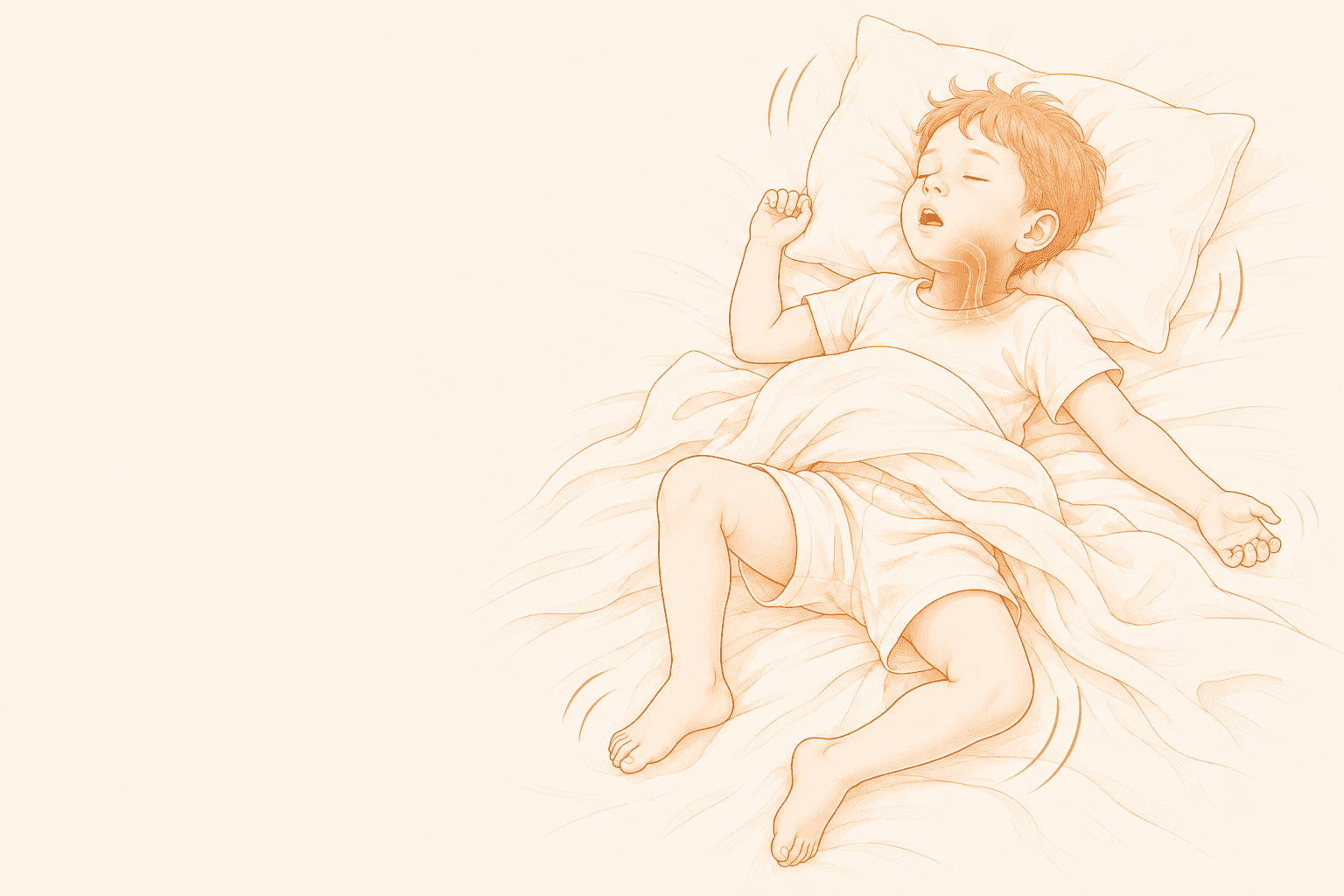
Kicking legs. Tossing all night. Waking at 2 AM. Sweat-soaked pillow. If your kid's sleep looks like a physical battle, the reflex is to think "restless personality." Often, it's the airway.
Here's how pediatric restless sleep connects to airway function, when it warrants evaluation, and where myofunctional therapy fits into the escalation path.

The Airway Connection
Airway-compromised sleep in kids produces micro-arousals — brief, subconscious wakings that fragment sleep without the child fully waking up. Those arousals present externally as tossing, kicking, position changes, sweating, and sometimes crying out. From the outside it looks like "restless personality." Physiologically it's compensation for reduced airflow.
Drivers include enlarged adenoids/tonsils (most common), allergies causing chronic nasal congestion, low tongue posture, and structural airway issues. All are evaluated at pediatric ENT. Kids sleep mouth-open guide →
Six Restless-Sleep Signs That Point Airway
Snoring nightly.
The single strongest marker. Warrants evaluation.
Mouth-open sleep.
Habitual mouth-open sleep = airway compromise even without snoring.
Bedwetting past age 5.
Documented correlation with pediatric sleep-disordered breathing.
Sweating during sleep.
Sympathetic overdrive from micro-arousals produces night sweating.
Restless legs / kicking.
Can be true RLS (medical evaluation warranted) OR airway-arousal downstream.
Morning grumpiness / focus issues.
Fragmented sleep produces daytime symptoms that mimic ADHD. Focus & airway →
Evaluation Path
1. Pediatrician screen.
Bring the sign list. Specifically request airway-focused evaluation before pursuing behavioral or ADHD paths.
2. Pediatric ENT.
Adenoid/tonsil evaluation, nasal structure, allergy screen. First-line for pediatric airway drivers. Adenotonsillectomy resolves many cases.
3. Iron / medical labs.
Low ferritin correlates with pediatric restless legs syndrome. Simple blood test. Worth ruling out.
4. Sleep study if warranted.
Pediatric polysomnography for confirmed apnea evaluation. Sleep physician-driven decision. Sleep pillar →
5. Myofunctional therapy adjunct.
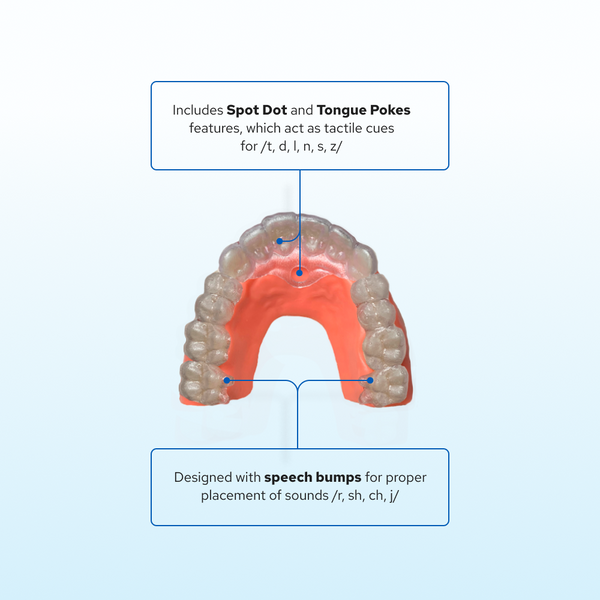
Post-ENT resolution, the low tongue posture and mouth-open habit often persist. Myofunctional work + Spot Pal Junior retrains the pattern, consolidating the sleep improvement.
"Our seven-year-old kicked all night, woke up crying, sweat through pajamas. Everyone said 'that's just her.' Pediatrician finally referred to ENT — massive adenoids. Post-surgery + Spot Pal Junior during quiet reading, she now sleeps like a rock. She wasn't 'restless' — she was suffocating quietly."
The Kids Sleep Adjunct Stack


Common Questions
Is restless sleep always airway?
No — can be RLS (iron deficiency), circadian, anxiety, or behavioral. Evaluation rules in / rules out. Airway is a common cause and should be checked early.
Will Spot Pal Junior fix restless sleep?
Only if driven by tongue posture / airway habit. Structural or medical causes need appropriate specialist care.
When should we get a pediatric sleep study?
Severe snoring, witnessed apneas, gasping/choking waking, or failure of first-line ENT interventions warrant polysomnography. Sleep physician makes the call.
How long before restless sleep quiets after adenotonsillectomy?
Many kids show significant improvement within 2-6 weeks post-surgery. Residual habit patterns often benefit from myofunctional adjunct.
Is our kid outgrowing this?
Some kids outgrow adenoid enlargement naturally. But downstream impact — palatal development, dental crowding, focus, growth — accumulates during the years the airway is compromised. Waiting isn't neutral.
Share:
Feeding Difficulties in Kids: When It's a Tongue Function Issue
Tongue Exercises For TMJ: The Muscle Upstream of the Clench