

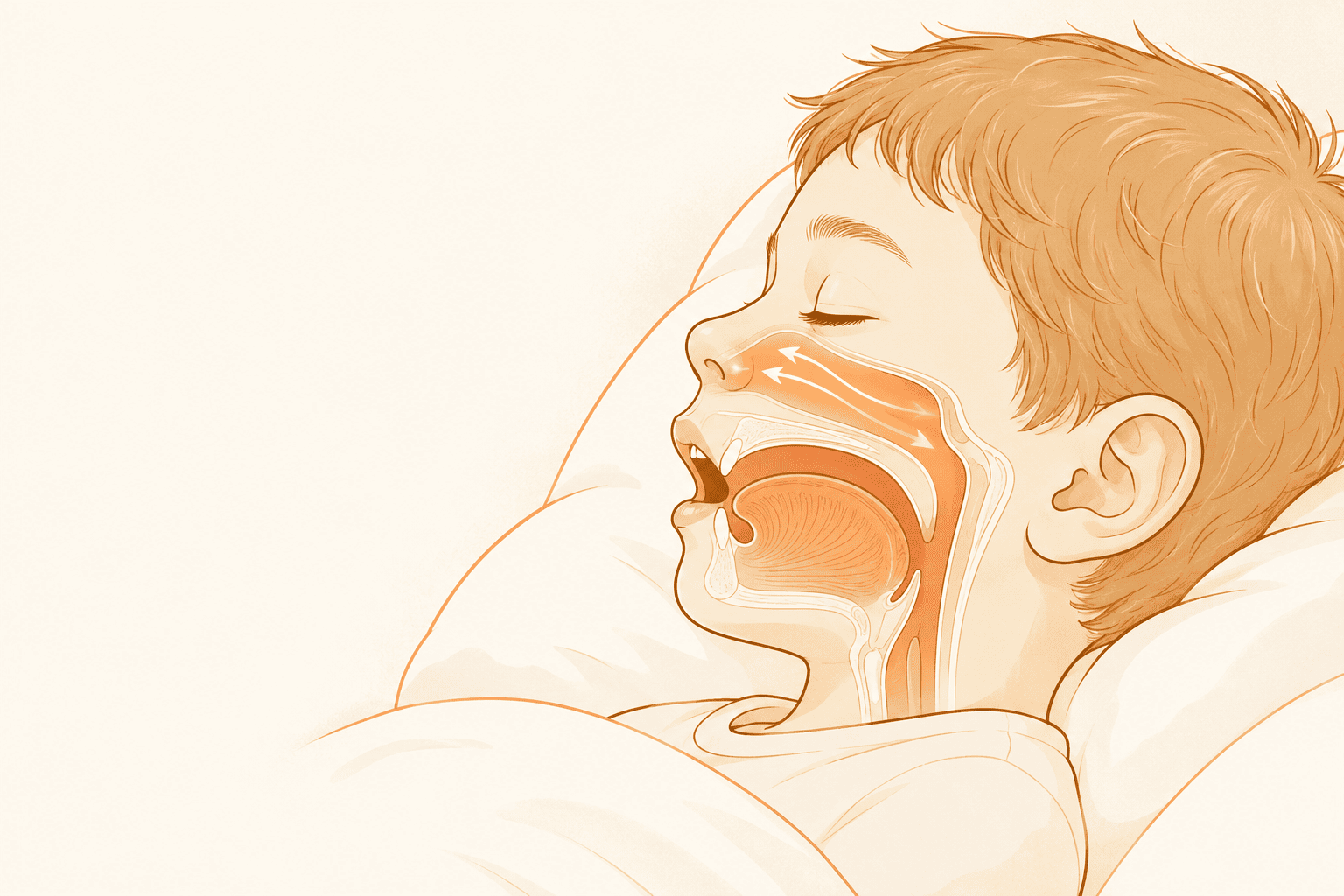
Your child sleeps with their mouth open. Their pediatrician says it's fine. Their dentist says it's fine. Their teacher says they're a little tired. But you notice — and you're right to notice. Pediatric mouth-open sleep is not benign, and it's not a phase.
Here's what mouth-open sleep in kids actually means for palatal development, focus, dental crowding, and long-term airway health — and the escalation path that actually addresses the cause.

Why This Matters More Than You've Been Told
Sleep-medicine research over the past two decades has documented that pediatric mouth-open sleep correlates with a cluster of downstream outcomes that shape how a child develops:
- Palatal shape. When kids breathe mouth-open at night, the tongue drops to the floor of the mouth. Without tongue pressure widening the palate, the palate develops high and narrow. This is the "adenoid face" phenotype — long face, narrow jaw, retruded chin. Structural changes that are hard to reverse in adulthood.
- Dental crowding. Narrow palates produce crowded teeth. Many orthodontic cases have their origin in childhood breathing pattern, not genetics as often assumed.
- Sleep architecture. Mouth breathing fragments the parasympathetic dip that runs slow-wave sleep. Kids get their "hours in bed" but not the actual recovery — showing up as behavioral irritability, focus issues, and daytime fatigue.
- Focus and attention. Pediatric sleep-disordered breathing shares a symptom profile with ADHD — inattention, hyperactivity, impulsivity. A meaningful subset of kids evaluated for ADHD have undiagnosed airway compromise.
- Bedwetting past age 5. Correlates with sleep-disordered breathing in pediatric research. Not a discipline issue.
- Speech and articulation. Low resting tongue posture from mouth-open habit reinforces tongue thrust and constrains articulation.
The developmental window matters. Palatal shape is highly plastic between roughly ages 3 and 12. Interventions in that window are disproportionately valuable. Kids-parent pillar →
Common Causes
Kids don't sleep mouth-open by choice. There's almost always a reason. Common ones:
1. Enlarged adenoids or tonsils.
The most common cause. Enlarged tissue partially blocks the nasal airway, forcing the child to compensate by breathing through the mouth. Pediatric ENT evaluation is the appropriate first step. Adenotonsillectomy is a common intervention that often resolves the pattern.
2. Allergies and chronic congestion.
Chronic nasal congestion from environmental allergies (dust mites, pet dander, seasonal pollens) or food allergies forces mouth breathing as a workaround. Allergy management can dramatically shift the pattern.
3. Structural nasal issues.
Deviated septum, nasal valve collapse, or high narrow palate (which itself narrows the nasal floor). ENT evaluation identifies structural issues that may need surgical or orthodontic intervention.
4. Low resting tongue posture.
Once the mouth-open habit is established, low tongue posture becomes self-reinforcing. Even if the initial cause (enlarged adenoids) is resolved, the neuromuscular pattern often persists. This is where myofunctional therapy and a patented resting-posture appliance like Spot Pal Junior come in. Mouth breathing pillar →
5. Tongue tie (ankyloglossia).
Restrictive lingual frenulum can prevent the tongue from reaching the palate at rest. Diagnosed by a myofunctional therapist, ENT, or dentist trained in tongue-tie evaluation. Sometimes surgical release (frenectomy) is indicated before myofunctional work can succeed.
The Escalation Path
Step 1 — Pediatric evaluation.
Start with the pediatrician. Describe what you're seeing. Request a referral to pediatric ENT for airway evaluation — this is standard when mouth-open sleep is nightly.
Step 2 — ENT assessment.
ENT evaluates adenoids, tonsils, nasal structure, and allergies. Adenotonsillectomy may be recommended if enlarged tissue is the driver. This resolves a majority of pediatric mouth-open sleep cases.
Step 3 — Pediatric sleep study if warranted.
If snoring is severe, witnessed apneas, or persistent daytime symptoms, pediatric polysomnography is the diagnostic gold standard. Pediatric obstructive sleep apnea is a medical diagnosis requiring specialist care. Myofunctional work is complementary, not a substitute. Sleep & airway pillar →
Step 4 — Pediatric myofunctional therapy.
Once acute causes (allergies, adenoids) are addressed, myofunctional therapy retrains the resting tongue and lip-closure pattern that persists after the trigger is gone. This is where Spot Pal Junior (ages 5-12) or Spot Pal Mini (entry-level) fits in — providing a tactile "spot" for the tongue during daytime practice. Healthy habits for kids →
Step 5 — Orthodontic coordination.
If palatal narrowness or dental crowding is present, orthodontic evaluation. Increasingly, orthodontists coordinate with myofunctional therapists — the combined approach produces more stable results than either alone.
"My son slept mouth-open, snored lightly, and his teacher had flagged focus issues. Pediatrician said 'lots of kids do that.' We pushed for ENT — enlarged adenoids. After the surgery he was still mouth-open (habit had locked in) so we added Spot Pal Junior during homework. Four months later mouth is closed at night, snoring is gone, and his teacher noticed the focus change before I told her anything."
Common Questions
My pediatrician says it's fine — should I push for ENT anyway?
If your child snores nightly, sleeps mouth-open habitually, has restless legs, bedwetting past age 5, or focus/behavioral issues, requesting ENT evaluation is appropriate and standard. Pediatricians increasingly refer, but many still under-refer for airway. Frame the request around what you're seeing: "I want to rule out adenoid/tonsil involvement."
When is surgery (adenotonsillectomy) actually necessary?
Pediatric ENT determines this based on tissue size, symptom severity, and impact on sleep. Adenotonsillectomy is one of the most common pediatric surgeries and often resolves the pattern completely. It's not routine — the ENT weighs the case individually — but it's a well-established intervention for enlarged adenoids/tonsils driving airway obstruction.
Can Spot Pal Junior fix this without other interventions?
Only in cases where the primary driver is neuromuscular habit rather than structural obstruction. Spot Pal Junior is a myofunctional appliance — it retrains tongue posture. It doesn't shrink adenoids, resolve allergies, or fix a deviated septum. Evaluation first is essential to determine if the mechanism fits.
My child had adenoids removed but still sleeps mouth-open — why?
Common. The initial cause (enlarged adenoids) is gone, but the neuromuscular habit of mouth-open sleep and low tongue posture has been established over years. This is exactly the case where post-surgical myofunctional therapy shows the strongest benefit — retraining the pattern that persists after the obstruction is resolved.
How long before we see a change?
Depends on the driver. If ENT resolves an obstruction, mouth closure at night can shift within weeks. If it's neuromuscular habit, expect 2-4 weeks for daytime rest-posture awareness, 6-10 weeks for consistent nighttime mouth closure with Spot Pal Junior use. Structural cases (palatal narrowness) take longer and often need orthodontic coordination.


Share:
Nightguard Cycling: Why You've Had Three And Still Have Pain
Spot Pal Junior vs Spot Pal Mini: Age & Case Guide