

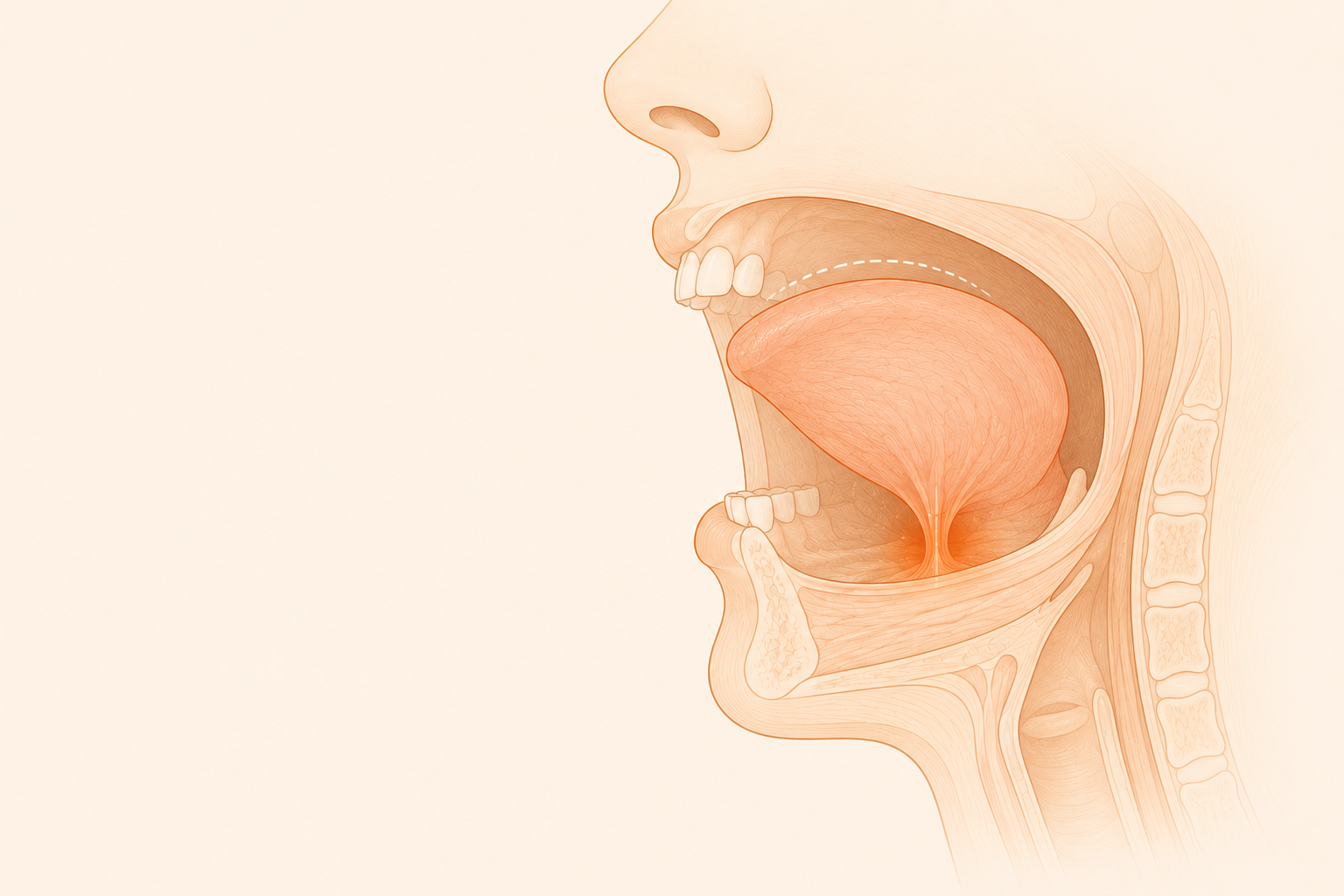
If you've been working on tongue posture for months and nothing's sticking — the tongue can't seem to reach the palate even when you focus, exercises fatigue you unusually fast — the issue may be structural, not habitual. Adult tongue tie (ankyloglossia) is one of the most under-diagnosed conditions in orofacial medicine, and it's often the reason myofunctional work stalls.
Here's what tongue tie is, how to know if you have it, and what the combined release + myofunctional protocol looks like.

What Tongue Tie Actually Is
The lingual frenulum is the small band of tissue connecting the underside of your tongue to the floor of your mouth. In some people, this band is short, thick, or attached too far forward — restricting tongue mobility. That restriction is ankyloglossia, colloquially known as tongue tie.
There are two main types clinicians recognize:
- Anterior tongue tie — visible restriction at the tip. Often obvious at birth; usually caught in infancy when it interferes with nursing.
- Posterior tongue tie — restriction deeper under the tongue, less visually obvious. Frequently missed at birth and pediatric checkups. This is the adult under-diagnosed category.
Posterior tongue tie doesn't produce the classic "heart-shaped tongue" appearance. It shows up functionally — reduced ability to lift the tongue to the palate, restricted lateral movement, fatigue with sustained tongue elevation. Which is exactly why myofunctional work stalls in undiagnosed cases. Tongue posture pillar →
Signs Your Adult Tongue Tie Was Missed
Tongue can't reach the palate.
The most direct functional test. Open mouth wide, try to touch tongue tip to the roof of your mouth. If you can't — or if the effort strains your floor-of-mouth muscles — likely restriction.
Chronic neck / jaw tension.
Restricted tongue movement forces accessory muscles to compensate. Chronic tension in the sternocleidomastoid, suboccipitals, and jaw musculature often traces to functional tie.
Speech carryover that never resolved.
Adult /r/, /l/, or /s/ patterns that childhood therapy couldn't fully generalize. If the tongue physically can't reach the position, no drill will produce it cleanly. Adult residual speech →
Sleep-airway markers despite good hygiene.
Mouth breathing, snoring, TMJ symptoms that persist despite all the right interventions. When the tongue anatomically can't seal the palate, downstream airway compromise is baked in.
Eating slowly / difficulty with certain textures.
Tongue lifts food to the palate for chewing and swallow. Restricted tongue makes texture management harder — chewy meats, leafy greens, wide bites all more effortful.
Myofunctional exercises fatigue you fast.
Whole-tongue suction exercises should be easy after a week or two. If they're still exhausting at week 6, the fascia/frenulum may be limiting range of motion — evaluation warranted. 5 tongue exercises →
The Evaluation & Release Path
Step 1 — Myofunctional therapist evaluation.
A trained orofacial myofunctional therapist can perform a functional tongue-tie assessment — mobility range, tongue elevation, lateralization. This is the appropriate first step, not a dentist visit.
Step 2 — Release evaluation with a trained dentist / ENT.
If functional restriction is confirmed, next step is evaluation by a dentist or ENT trained specifically in adult frenectomy. Laser and scissors techniques both used. This is not standard general-dentistry work — find a specialist.
Step 3 — Pre-release myofunctional prep (4-6 weeks).
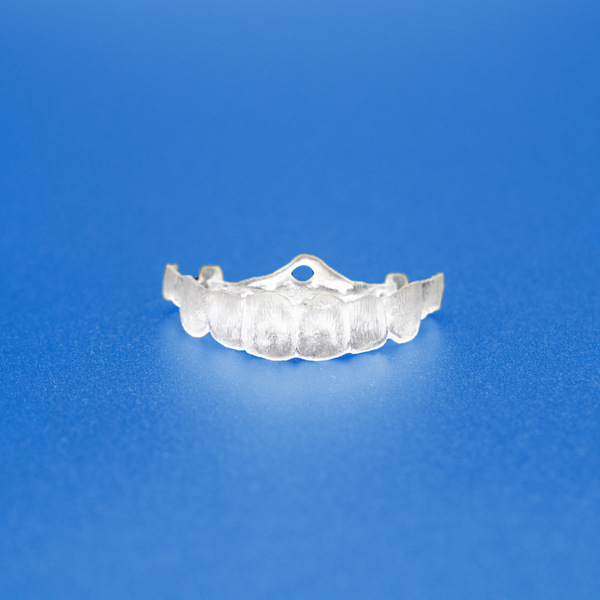
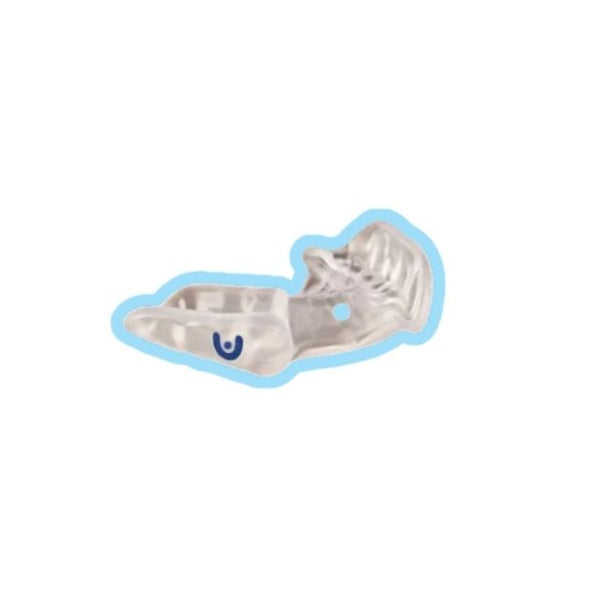
Best practice is 4-6 weeks of myofunctional exercises BEFORE release. Prepares the tongue musculature to use the new range of motion. Adult Spot Pal introduced during this phase as tactile anchor.
Step 4 — Release procedure.
In-office procedure, typically 10-15 minutes. Local anesthesia. Recovery over 1-2 weeks. Some tenderness, minimal disruption.
Step 5 — Post-release rehabilitation (8-12 weeks).
Immediate post-release, wound-care exercises to prevent reattachment. Then aggressive myofunctional work to build strength and range in the newly-freed tongue. This is where the patented Adult Spot Pal shines — passive rest-posture anchor during the retraining phase. Neuromuscular pattern rewrites over 8-12 weeks. TMJ pillar →
"Thirty-eight, chronic upper-back and jaw tension for a decade. Two rounds of PT, no lasting fix. Started myofunctional work — exercises just wouldn't stick, tongue couldn't reach the palate. Therapist referred out for tongue tie evaluation. Turned out to be significant posterior tie. Release + eight weeks of post-op myofunctional work with Adult Spot Pal — tongue reaches the palate for the first time in my adult life. Jaw tension gone."
The Post-Release Rehab Stack

Common Questions
How do I find a provider who evaluates adult tongue tie?
Start with a trained orofacial myofunctional therapist — they perform functional assessments. For release, look for dentists or ENTs trained specifically in adult frenectomy techniques. The Academy of Orofacial Myofunctional Therapy (AOMT) and Breathe Institute provider directories are good starting points.
Is the release surgery worth it as an adult?
Depends on the functional impact. For adults with significant downstream issues (chronic tension, TMJ, unresolved speech, airway markers) that trace to restricted tongue mobility, release + rehabilitation shows meaningful benefit. For mild functional restriction with no downstream issues, watchful waiting with myofunctional-only work is reasonable.
Is release covered by insurance?
Coverage varies significantly. Some medical plans cover release when clearly documented as medically necessary (airway involvement, feeding issues in nursing mothers, etc.). Dental plans often cover pediatric release, less often adult. Check with provider billing and plan administrator.
What's the recovery like?
Tenderness for 3-5 days. Wound-care exercises multiple times daily for 2 weeks to prevent reattachment. Return to normal eating within 1 week for most patients. Full rehabilitation with myofunctional retraining runs 8-12 weeks.
Can I skip release and just do myofunctional?
For mild restriction — sometimes yes, exercises alone stretch the fascia enough to gain functional range. For significant restriction, exercises will plateau because the anatomical limit is real. Myofunctional therapist assessment determines which category you're in.
Share:
Palatal Expansion & Myofunctional Therapy: Why They Belong Together
Snoring Solutions Beyond CPAP: A Practical Decision Guide