

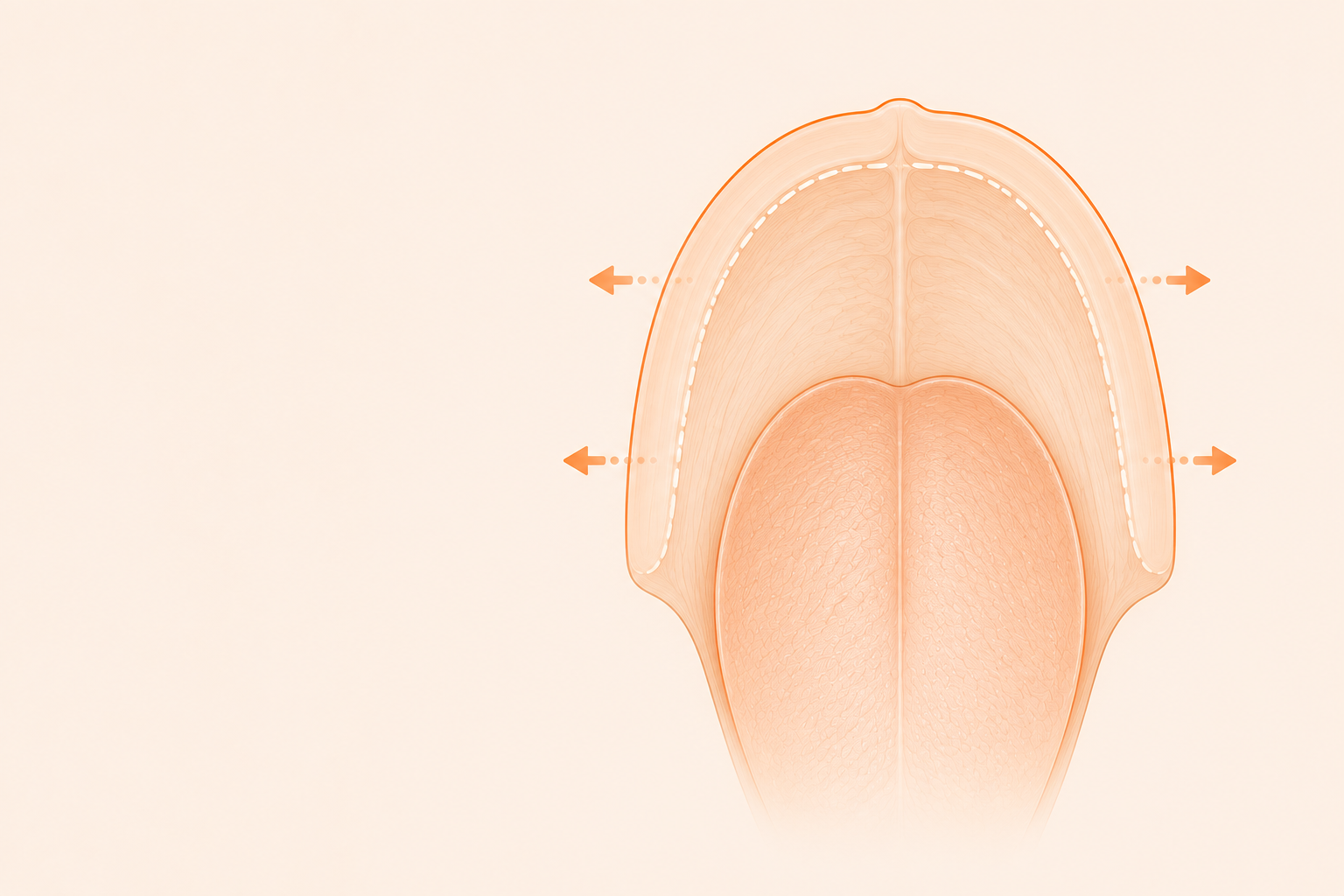
If your child's orthodontist recommended a palatal expander, they're addressing a structural problem — a narrow palate. What most orthodontic protocols don't include is the reason the palate got narrow in the first place, and the neuromuscular work that keeps it wide after treatment.
Here's why palatal expansion + myofunctional therapy pair powerfully, and how a patented tongue-training appliance fits into a coordinated pediatric protocol.

Why Palates Get Narrow In The First Place
The palate develops under the pressure of the tongue. When a child's tongue rests against the roof of the mouth — the mature default — that upward pressure across years shapes the palate into a broad, flat arch. That's the developmental target.
When the tongue lives in the floor of the mouth instead — as with chronic mouth breathers, tongue thrust cases, and kids with low resting posture — that upward pressure is absent. Without it, the palate develops narrow and vaulted. The classic "high narrow palate" that ends up in orthodontic evaluation at age 9 is often the structural signature of years of low tongue posture.
This matters because if you only expand the palate structurally without addressing the underlying tongue posture, the pattern that created the narrow palate is still running. Post-expansion relapse is common when the substrate isn't retrained. Kids-Parent pillar →
The Combined Protocol
A growing number of pediatric orthodontists coordinate with myofunctional therapists specifically to reduce post-expansion relapse. The combined protocol runs in parallel phases:
Phase 1 · Pre-expansion evaluation.
Myofunctional therapist assessment before or at the same time as orthodontic workup. Identify tongue thrust, low resting posture, mouth breathing, tongue tie — the drivers of the narrow palate.
Phase 2 · Airway evaluation.
If snoring, mouth-open sleep, or enlarged adenoids are present, ENT evaluation before or alongside expansion. Airway issues drive palatal narrowness — addressing both at once is standard best practice. Kids sleep mouth-open →
Phase 3 · Active expansion + myofunctional exercises.
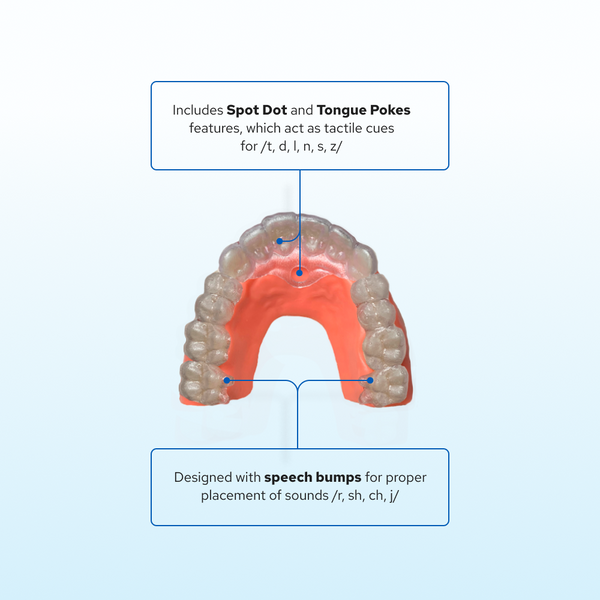
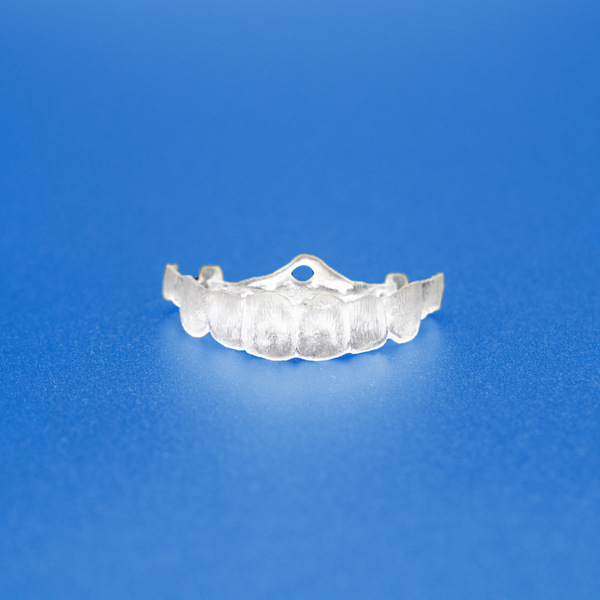
Orthodontist runs the expander (typically 4-12 weeks of active expansion, then stabilization). Myofunctional therapist runs parallel tongue posture, lip closure, and swallow drills. Spot Pal Junior often introduced here as tactile anchor during homework.
Phase 4 · Post-expansion consolidation.
Once expansion is stable, myofunctional work continues for 3-6 months of substrate consolidation. This is where relapse reduction happens — tongue holds the palate wide because it now habitually rests there.
Why Myofunctional Alone Isn't Always Enough
Fair question: if myofunctional work is so important, why not skip the expander? Sometimes you can — for younger kids (3-6) with mild palatal narrowness caught early, exercise-based work alone may shift the palate over time.
For most kids in orthodontic-referral range (8-12), the palatal narrowness has been structural for years. The suture between the two halves of the palate is starting to fuse. Myofunctional pressure alone won't widen it fast enough within the developmental window. That's why palatal expansion is often the right structural intervention — and myofunctional work is the substrate that makes it stick.
Discuss the case-specific answer with a pediatric orthodontist and myofunctional therapist together. Many now consult jointly. Practical exercises →
"My son had an expander at 9 for a narrow arch. His orthodontist also referred us to a myofunctional therapist — I hadn't heard of that pairing before. Six months of exercises during expansion plus Spot Pal Junior during reading. Two years later his palate has stayed exactly where the expander put it. His younger brother got the same setup preventively at 7 — no expander needed."
The Pediatric Orthodontic-Adjunct Family
Common Questions
Can we skip the expander and just do myofunctional work?
Case-dependent. For younger kids (3-6) with mild narrowness caught early, exercise-based work sometimes shifts the palate over time. For most orthodontic-referral cases (8-12), the palatal suture is starting to fuse and myofunctional pressure alone isn't fast enough. Coordinate with a pediatric orthodontist to know which fits your case.
When should we start Spot Pal Junior — before, during, or after expansion?
Typically during and after. Pre-expansion phase focuses on evaluation and mouth-breathing / airway resolution. Once the expander is active (Phase 3), Spot Pal Junior provides the passive tongue-palate anchor during homework hours. Continues through Phase 4 for consolidation.
Does insurance cover this combined protocol?
Orthodontic expansion is typically covered under dental/orthodontic benefits. Myofunctional therapy coverage varies significantly — some plans cover SLP-provided myofunctional work under speech benefits, others don't. Spot Pal Junior is typically out-of-pocket. Check HSA/FSA eligibility with your administrator.
How much does myofunctional work reduce post-expansion relapse?
Effect-size data is emerging. Clinical experience among coordinated orthodontist-myofunctional pairs consistently reports lower relapse rates than expansion-alone. Formal RCT data specific to this pairing is still limited but growing. Mechanism is well-established.
Our orthodontist doesn't mention myofunctional therapy — should we push for it?
Yes — worth asking. Not every orthodontist coordinates with myofunctional providers yet, but most are open when parents raise it. Ask specifically: "Would myofunctional therapy reduce relapse risk in our child's case?" Their answer will tell you whether they think in these terms.
Share:
Nasal Breathing for Runners: How to Push Your Aerobic Ceiling
Tongue Tie in Adults: The Diagnosis Nobody Made In Childhood