

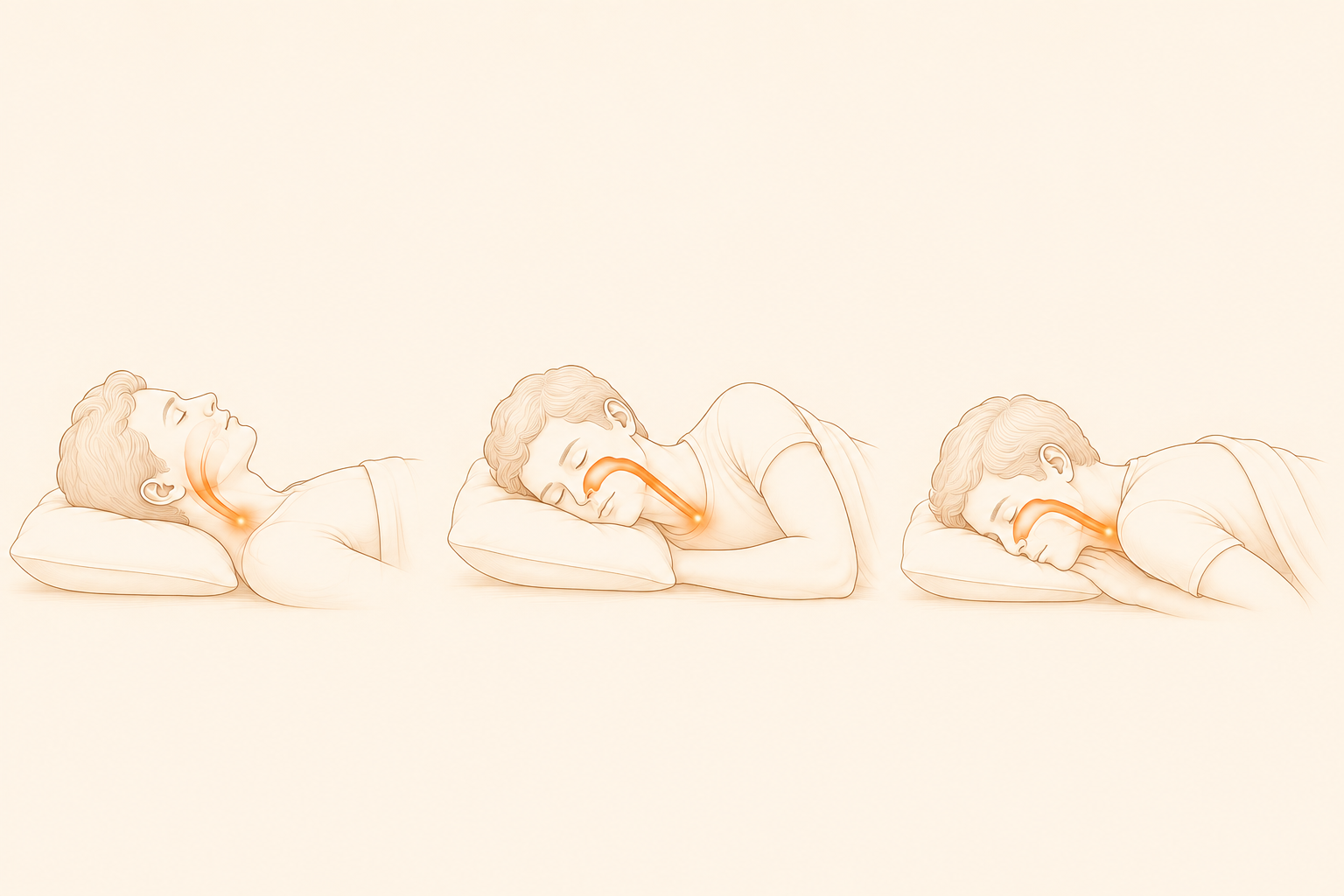
If you sleep on your back and snore, the position is the fastest thing you can change tonight. What most sleep-hygiene guides don't explain is why — and how tongue posture changes which position actually works for your airway.
Here's the clinical breakdown of side, back, and prone sleeping, what happens to your airway in each, and when position alone can shift snoring severity meaningfully.

The Airway Physics Of Each Position
Gravity affects the airway differently depending on how you're lying. Where the tongue and soft palate rest — and whether they can partially collapse into the pharyngeal space — changes with your orientation.
Supine (back sleeping) — the worst for most airways.
Gravity pulls the tongue backward toward the throat. The soft palate hangs down. The mandible drops. Together these narrow the pharyngeal airway. Supine sleeping is the position most strongly correlated with snoring severity in sleep-medicine research — and where positional therapy for mild-to-moderate OSA is aimed. If you sleep on your back and snore, this is why.
Lateral (side sleeping) — usually best.
Gravity pulls the tongue laterally, not into the throat. The airway stays more open. For most snorers with mild positional apnea, side-sleeping alone reduces respiratory events meaningfully. This is why sleep specialists often recommend it as first-line positional therapy. Sleep & airway pillar →
Prone (stomach sleeping) — mixed picture.
Airway-wise, prone can be favorable — the tongue can't collapse backward — but the neck rotation typically required to breathe creates chronic cervical strain. Most prone sleepers develop neck issues over time. Not usually recommended as a permanent solution.
Position Alone vs Position + Posture
Positional therapy is real medicine — for mild positional obstructive sleep apnea, it can meaningfully reduce AHI. What it doesn't do is address the underlying reason the tongue collapses so easily. That's a resting-posture question.
Kids and adults with well-trained resting tongue posture — tongue habitually sealed against the palate — tolerate supine sleep with less airway compromise. The tongue doesn't fall back as far because its default position is up-and-forward. This is why myofunctional therapy has documented adjunct value in sleep-airway populations: it improves the substrate that determines how much position matters. Tongue posture pillar →
Practical Ways To Stop Rolling Onto Your Back
The hard part isn't deciding to side-sleep. It's staying on your side. Chronic back-sleepers often revert unconsciously through the night.
Tennis-ball technique.
Old-school but works. Sew or attach a tennis ball to the back of your sleep shirt. Rolling onto your back becomes uncomfortable enough to shift back to your side.
Positional-therapy devices.
Commercial vibrating position monitors buzz gently when you roll supine, retraining position over 4-6 weeks. Some sleep physicians prescribe these for mild positional OSA.
Body pillow.
Full-length body pillow you hug in front and press against behind. Physical anchor that most side-sleepers find helps them stay put.
Elevate head of bed 4-6 inches.
Wedge or bed risers under the head-of-bed legs. Slight incline reduces gravity's effect on the airway even in supine, and helps GERD symptoms too. Documented in positional therapy research.
When Position Alone Won't Fix It
Positional therapy has limits. If any of these apply, escalation to medical evaluation is warranted:
- Severe snoring even on your side.
- Witnessed pauses in breathing.
- Gasping / choking awakenings.
- Daytime sleepiness affecting driving or work safety.
- Documented moderate-to-severe apnea on a prior sleep study.
These warrant sleep-physician evaluation and formal treatment — CPAP or oral appliance therapy under specialist care. Position + myofunctional work are complementary adjuncts, not substitutes for prescribed apnea therapy. Sleep apnea treatment options →
"My partner started sleeping in the other room because of my snoring. Got a sleep study — mild positional apnea. Switched to side-sleeping with a body pillow, added Adult Spot Pal during work hours. Three months later my partner moved back. Same body. Different position, different tongue habit."
The Sleep Support Stack
Common Questions
Left side or right side?
For airway alone, either side works. For GERD-related sleep issues, left-side has documented benefit (reduces reflux frequency). Pregnant sleepers are typically advised left-side to improve maternal-fetal blood flow. Otherwise, personal preference.
What if I only snore on my back?
Classic positional pattern — often responds well to sleeping on your side + head-of-bed elevation. If it's severe or accompanied by daytime sleepiness, a sleep study confirms whether it's mild positional apnea (which position + myofunctional work can address as adjunct) or something requiring formal CPAP/appliance treatment.
Can I train myself to stay on my side?
Yes. Most chronic back-sleepers transition within 4-6 weeks using positional cues (tennis ball, body pillow, wedge). After that period, side-sleeping typically becomes the new default without device support. Some people revert during high-stress sleep — that's when the cue helps most.
Does side-sleeping help kids with mouth-open sleep?
It can help mildly, but pediatric mouth-open sleep more often has structural drivers (enlarged adenoids, allergies) that position alone won't fix. Combine with pediatric airway evaluation. Kids sleep mouth-open guide →
Should I wear Night Pal if I side-sleep?
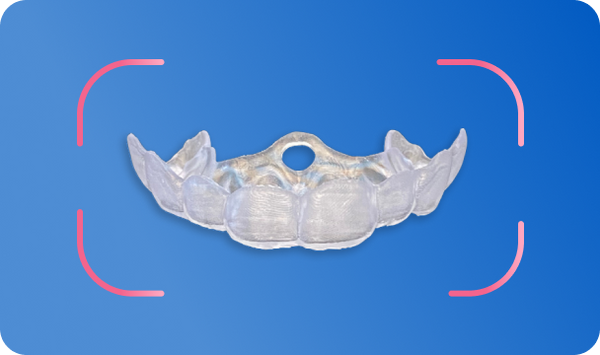
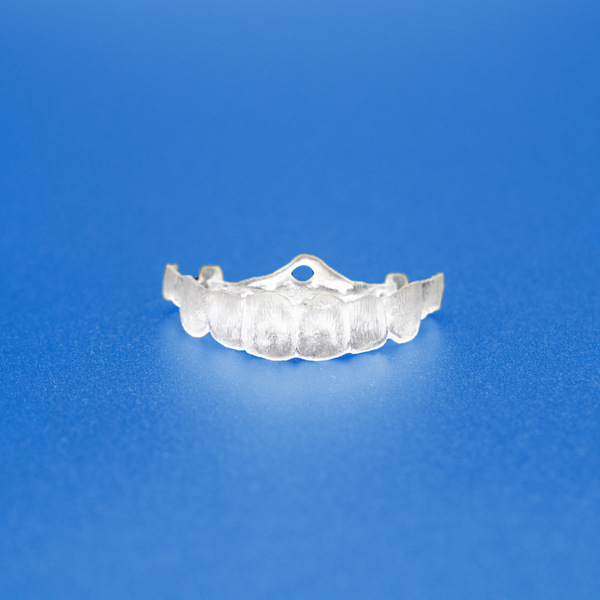
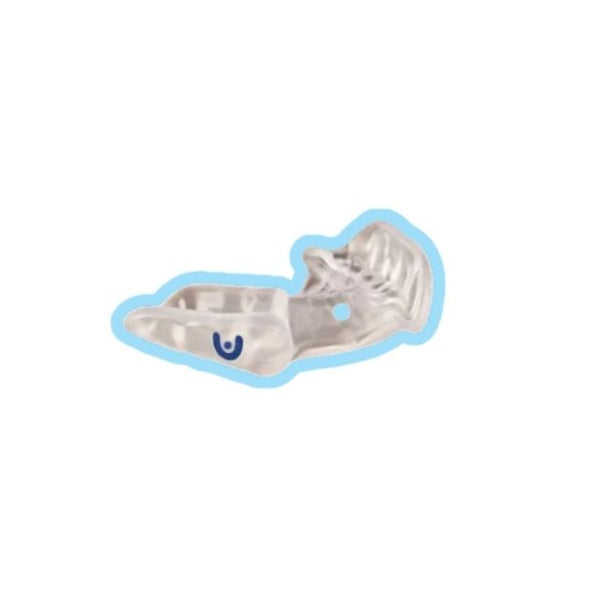
Independent question — Night Pal is prescribed based on whether you're grinding your teeth (bruxism), not sleep position. If you're a side-sleeper who also grinds, yes — position addresses airway, Night Pal protects the teeth from the clench pattern that side-sleeping may partially reduce but doesn't eliminate.
Share:
From Lips to Hips: How Tongue Position Influences Your Whole Postural Chain
How Mouth Breathing Affects Sleep Quality & Overall Health