


Every endurance athlete has a ceiling their VO2 max can't explain. You train hard, run smart, eat well, still hit the same wall at the same tempo, race after race. The variable that isn't in your Garmin data is CO2 tolerance — and it's the one you can actually train.
Here's what CO2 tolerance is, why it matters more than most endurance coaches teach it, and how to progress it with nasal-breathing work and a patented tongue-posture appliance.

What CO2 Tolerance Actually Is
CO2 tolerance is how much carbon dioxide your body can accumulate before your nervous system triggers the urgent "must breathe" reflex. Higher CO2 tolerance means you can hold slower, deeper, more controlled breathing under load — which lets you extract more oxygen per breath and delay the switch to panicked, shallow mouth breathing.
The underlying mechanism is the Bohr effect. Hemoglobin releases oxygen to muscle tissue in the presence of CO2. Chronic hyperventilation (which most mouth-breathers unconsciously do under load) blows CO2 off too fast, which paradoxically means less oxygen delivery to working muscles. You're breathing more, delivering less. The whole system runs inefficient.
Endurance training as typically structured builds cardiovascular capacity — the pump. It doesn't necessarily build CO2 tolerance — the receiver. Athletes with big cardio engines but low CO2 tolerance leak efficiency at their tempo ceiling. Mouth breathing pillar →
The Nasal Breathing Connection
Nasal breathing is CO2-tolerance training baked into the mechanics of your workout. Compared to mouth breathing at the same intensity, nasal breathing:
- Slows respiratory rate. The physical resistance of the nasal passage naturally paces breathing.
- Deepens each breath. Slower rate + same air need = larger tidal volume, better lung utilization.
- Retains more CO2. Allows the Bohr effect to work — oxygen offloads to muscle where it's needed.
- Produces nitric oxide. Nasal breathing releases NO in the sinuses, a vasodilator that increases oxygen uptake in the lungs.
- Keeps the tongue-palate seal engaged. The tongue sealing the palate keeps the airway open at the top and stabilizes head posture — small biomechanical wins that compound across a long run. Tongue posture pillar →
Studies in endurance-athlete populations (Dallam, MacIntosh et al., Int J Kinesiol Sports Sci) have documented respiratory efficiency gains in athletes trained nasal-only over 4-6 weeks. The evidence base isn't hypothetical — it's why elite endurance coaches have been quietly working it for a decade.
The Training Progression
You don't add a training block. You retrofit your existing endurance work by progressing what percentage of it stays nasal.
Weeks 1-2 — Nasal at rest & walking
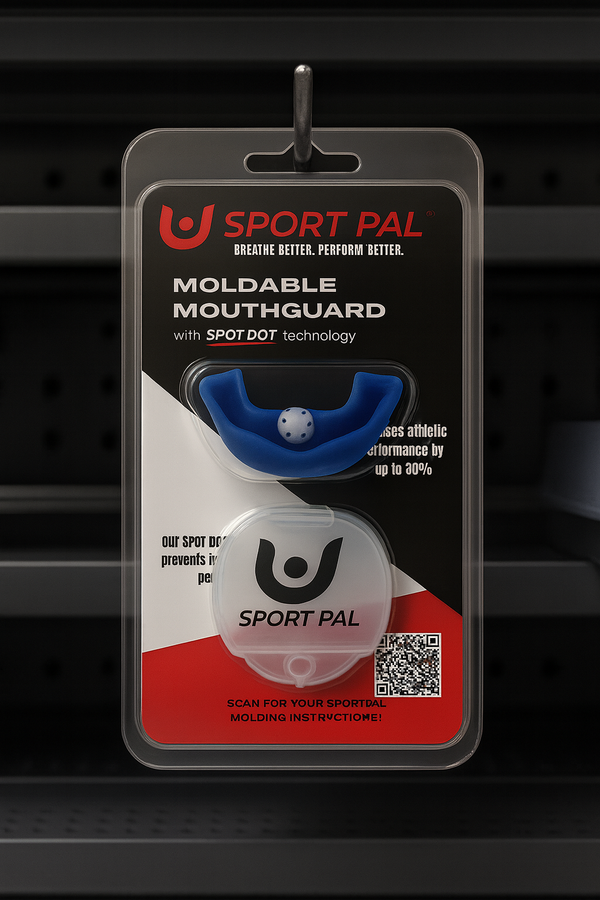
Nasal-only during walks, warm-ups, and mobility. If your nose feels congested, that's expected — nasal tissue adapts over the first 10-14 days. Start wearing Boil & Bite Sport Pal during these low-intensity windows to reinforce tongue-palate seal.
Weeks 2-4 — Nasal at Zone 1-2
All easy aerobic runs, all recovery rides, all zone-1-to-2 work becomes nasal-only. If your breath collapses to mouth, back the pace down until nasal holds. This is where the CO2 tolerance expands — sustained sub-threshold work forces the adaptation.
Weeks 4-8 — Nasal into Zone 3 tempo
Tempo runs, threshold rides, sustained bag work — extend nasal breathing into moderate output. The transition point where nasal collapses to mouth is measurably higher now. That's your CO2-tolerance ceiling pushing up. Five breathing exercises →
Weeks 8+ — Race-context carryover
In competition, everyone mouth-breathes at max effort — that's built in. What's changed is when. The old collapse point at mile 8 becomes a collapse point at mile 12. That's the training win. Continue Sport Pal in warm-ups and tempo sessions to reinforce the pattern indefinitely. Sleep and sport performance →
Where Recovery Fits
CO2 tolerance work compounds with sleep-based recovery. Nasal breathing during the day carries into nasal breathing at night, which improves sleep architecture, which improves the CNS supercompensation that turns training load into fitness. This is why the Athletic pillar keeps circling back to the airway — every downstream system in endurance sport traces upstream to how you're breathing.
Endurance athletes with disrupted sleep from mouth-open breathing plateau even with perfect training programming. Fixing the airway is often the single highest-leverage recovery intervention available. Five recovery techniques →
"Marathoner, decent times, always felt like I bonked mentally before I bonked physically. Coach put me on nasal-only Zone 2 for eight weeks with Boil & Bite Sport Pal during long runs. The change wasn't my pace at 20K — it was my clarity at 32K. I stopped making the bad decisions that come from CO2 dysregulation. Racing feels different when the brain's still online at mile 20."
Common Questions
Will this improve my race times?
We don't make PR claims. What athletes consistently report is later mental fade in long races, later gas-out in tempo work, faster between-set recovery, and better late-race decision-making. Whether that shows up on the clock depends on the athlete, the program, and the race. If your ceiling has been breath-related, the effect can be meaningful.
Do I need to be nasal-only in races?
No. Everyone mouth-breathes at max effort, and that's part of the physiology. The point of nasal-breath training isn't to be nasal-only forever — it's to raise the intensity ceiling where the transition to mouth breathing happens. In a race, you'll still switch. Just later.
Is CO2 tolerance the same as VO2 max?
No. VO2 max is your maximum oxygen uptake capacity — largely genetic-limited, hard to move significantly with training. CO2 tolerance is your body's ability to handle accumulated CO2 without triggering the urgent-breathing reflex — highly trainable in a matter of weeks. Two different variables. Both matter.
Should I use Boil & Bite Sport Pal during long runs?
Many endurance athletes use it for warm-ups and Zone 1-2 runs. For threshold and race-pace work, personal preference — some find the tactile anchor helpful, others prefer running without it once the pattern is autonomous. Sport Pal is designed to be worn during athletic training under mild-to-moderate output.
What if my nose is chronically blocked?
First 2 weeks of nasal-training some blockage is expected. Beyond that, chronic congestion warrants evaluation for allergies, deviated septum, or chronic sinusitis — an ENT visit is worth it. Structural issues at the nasal passage are fixable and often unlock significant training gains.

Share:
Practical Exercises for Articulation
Nightguard Cycling: Why You've Had Three And Still Have Pain